How to Prevent SaaS Customer Churn: A Practical Guide for Startups
Getting your first 10 paying customers feels like a finish line. It isn’t. It’s where the harder job starts.
When your customer base is that small, every cancellation affects your customer count. Once the cancellation takes effect, your monthly recurring revenue (MRR) falls too. The cash impact depends on your billing arrangement.
That’s why founders need to prevent SaaS customer churn before they chase more signups. And it takes more than a “just checking in” email sent after someone has already decided to leave.
This guide covers SaaS customer retention for startups in a way one founder can actually run. You’ll see why churn hits small teams harder, seven strategies that work without a customer success department, a real case study from Groove, and a 30-day plan you can start this week.
One note before we begin: Kitelane, the example company used in this guide, is made up. The Groove case study is real, and the sources are listed at the end.

Why SaaS Customer Churn Hits Startups Harder
A large company can spread churn across thousands of customers. A startup usually can’t.
One lost customer changes the whole picture
Meet Kitelane, a made-up reporting tool for small marketing agencies. It has 10 paying customers: eight pay $100 a month and two pay $300. MRR is $1,400.
Two terms matter here:
- Customer churn is the share of your starting customers who cancelled during a period.
- Revenue churn is the recurring revenue cancelled by your starting customers, divided by the MRR at the start of that period. (Downgrades are a separate measure, so we’re leaving them out.)
Now one of the $300 customers cancels. Kitelane has lost 1 of 10 customers, so customer churn is 10%. It has also lost $300 of $1,400 in MRR, so revenue churn is about 21%.
If a $100 customer had left instead, customer churn would still be 10%. Revenue churn would be about 7%.
Same headcount, very different damage. That’s why you should track customer churn and revenue churn separately.
If you’re still building that first group, our guide on getting your first 10 B2B SaaS customers is a good place to start.
Founders can’t rely on a customer success team
At this stage, you are the customer success team. You’re also the support desk, the product manager and, usually, the person who closes the sales.
That has an upside. You can talk to every customer, and you can notice trouble early. But manual work only holds up if you do it on a schedule, not when you remember.
Everything below is built for that reality.
7 SaaS Churn Prevention Strategies for Startups
These SaaS churn prevention strategies follow the order a customer experiences your product, from the first promise to the renewal date.
1. Understand what customers expect before they onboard
Ask every new customer one question: “What result do you want from this in the first month?”
Write the answer down. Then check it against what your product really does.
If a customer expects a feature you don’t have, tell them now. A small disappointment on day one beats a cancellation on day 60.
2. Define the first result customers should reach
Every product has a moment where the customer thinks, “Okay, this works.” For Kitelane, it’s the first client report sent without manual editing.
Name that moment for your product, and measure how long customers take to reach it. If that time is growing, something in your setup is getting in the way.
3. Stay connected with paying customers
Schedule a short check-in at fixed points, such as day 14 and day 45. Ask what they used this week and what got in their way.
Keep it conversational. You’re looking for problems, not compliments.
Don’t skip customers who seem happy. A customer who says nothing may still be struggling. And if a happy customer is willing to introduce you to someone else, a simple customer referral process makes that easy.
4. Monitor whether customers are getting value
Pick two or three actions that signal real use. For a reporting tool, that might be reports sent and data sources connected.
Check them weekly. Note who is slowing down.
Then connect usage to outcomes. A customer who logs in often but never sends a report isn’t getting the value they paid for.
5. Fix the problems that keep coming back
Keep a running list of customer complaints. One complaint is a note. The same complaint from multiple customers may point to a recurring priority.
Separate bugs that block people from feature requests that would be nice to have. Fix the blockers first.
Tell customers when you fix something they reported. It shows them you listen.
6. Make pricing match the value customers receive
Some customers leave because they feel they pay more than they get, even when the product works fine.
Look at your cancellations and your support threads for price-related comments. Then ask whether your pricing model fits how customers actually use the product.
If you sell an AI product, our guide to usage-based vs subscription pricing for AI products shows how billing choices affect margins. Read it before you change anything.
7. Start renewal conversations early
Don’t wait for a cancellation request to talk about the future.
A few weeks before renewal, review what the customer has achieved and ask what’s still missing. Objections you hear early are objections you can still fix.
Early-Stage SaaS Customer Retention: Your First 30 Days
The first month shapes how a customer sees your product, although churn can happen at any stage. Strategy 2 covered what customers should reach. This section covers when you check in.
If you’re still testing your setup experience, see our guide on how to test a user onboarding flow.
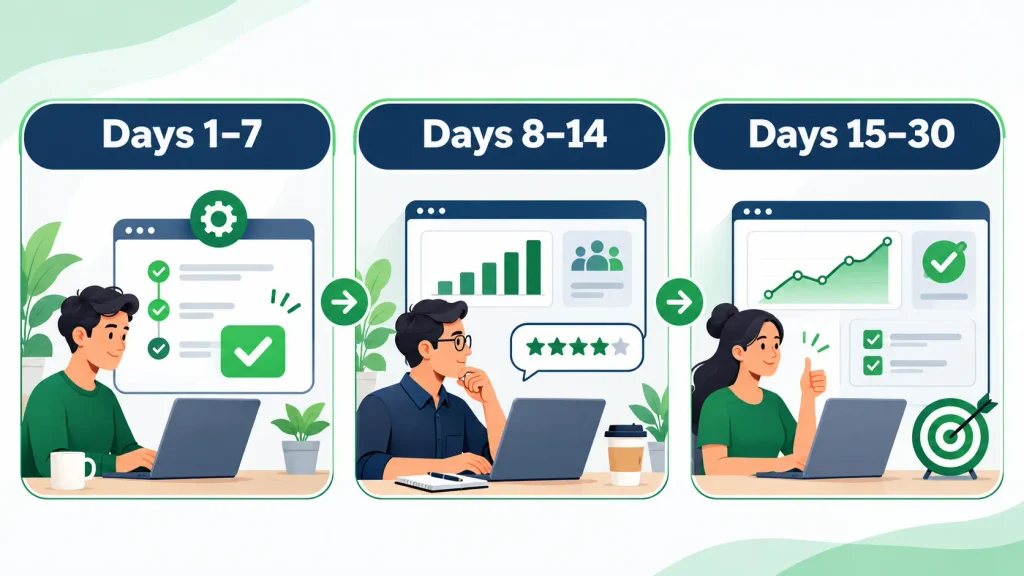
Days 1–7: Help customers start well
Confirm that setup is finished. Help them complete their first important task.
If they’re stuck, remove the obstacle yourself. A quick call may help resolve the problem before it leads to a cancellation.
Days 8–14: Check whether they’re getting value
Review their usage. Ask what has been hard so far.
This is also the time to catch mismatched expectations, such as a customer waiting on a feature that isn’t coming.
Days 15–30: Strengthen adoption
Look at progress against the goal they gave you on day one. Fix any repeated problem.
Then agree on the next useful milestone, so the customer has a reason to keep going.
| Period | Founder action | Expected outcome |
|---|---|---|
| Days 1–7 | Setup and first task | Initial product value |
| Days 8–14 | Usage and feedback review | Friction identified |
| Days 15–30 | Progress check | Stronger adoption |
Case Study: How Groove Cut Churn by 71%
Theory is useful. Here’s what it looked like at a real startup.
Groove, a help desk software company, was dealing with monthly churn of 4.5% in 2013. New customers kept arriving, but too many left, and growth couldn’t hold.
Simple compounding math shows why that matters. If monthly churn stayed at 4.5% and you ignore new signups and other account changes, a company would lose about 42% of its starting customers in a year. (That’s our calculation, not a figure Groove published.)
The team didn’t know why customers were leaving. So they compared the behavior of people who left in their first 30 days with people who stayed.
What they found
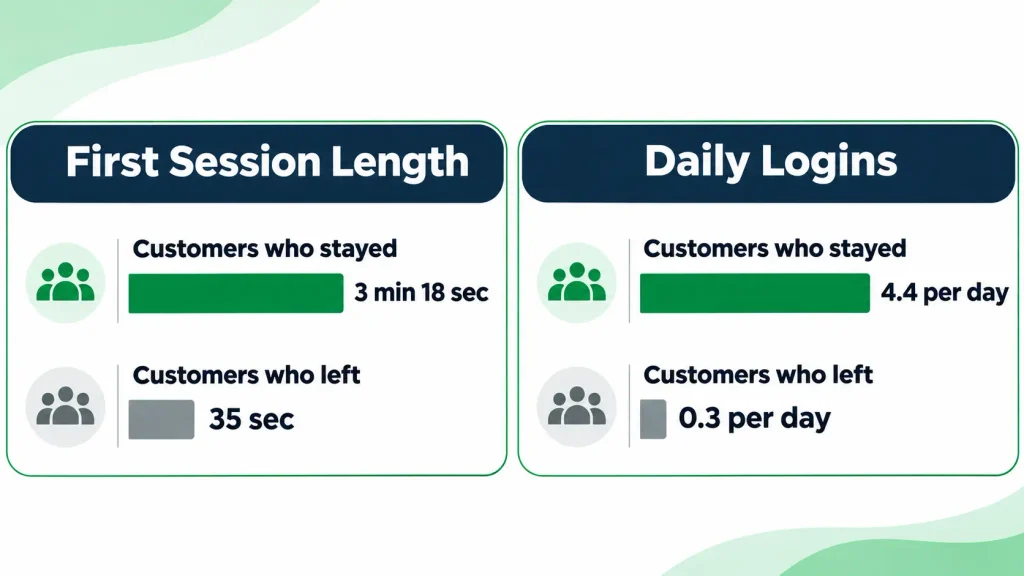
Two behaviors stood out in the first 30 days:
- First session length. Customers who stayed had an average first session of 3 minutes 18 seconds. Customers who left averaged 35 seconds.
- Login frequency. Customers who stayed logged in about 4.4 times a day. Those who left logged in about 0.3 times a day.
Groove called these “Red Flag Metrics” because they showed who was at risk before anyone cancelled.
What they did about it
They sent targeted emails based on those signals.
Customers whose first session was under two minutes got an offer to help with setup. About 26% replied, and more than 40% of the people who finished setup were still customers after 30 days.
Customers who logged in fewer than two times in their first 10 days got a different message. Roughly 15% replied, and almost half of those who replied were still using Groove after 30 days.
Groove liked the results enough to build similar emails into onboarding for every new customer. CXL’s case study describes Groove’s work as reducing churn by 71%.
What you can take from it
- Churn rarely starts at cancellation. Early behavior can show trouble weeks before.
- A short, personal offer to help works better than a generic reminder.
- Your own signals will differ. Don’t copy Groove’s numbers. Look for the behaviors that separate customers who stay from customers who leave in your product.
A fair warning: these are Groove’s own historical results from a different product, not a benchmark for yours. With 10 customers, you can’t run the same analysis. But you can watch each customer’s first month by hand, and that’s the same idea at your size.
Track Churn Risk With Your First 10 Customers
You don’t need software to start. A spreadsheet is enough.
Build a simple retention tracker
Create one row per customer and update it every week:
| Customer | Last active | Usage trend | Unresolved issue | Renewal status |
|---|---|---|---|---|
| Customer A | Recent | Stable | None | On track |
| Customer B | 10 days ago | Declining | Setup issue | Review |
| Customer C | Recent | Increasing | None | On track |
Illustrative data only.
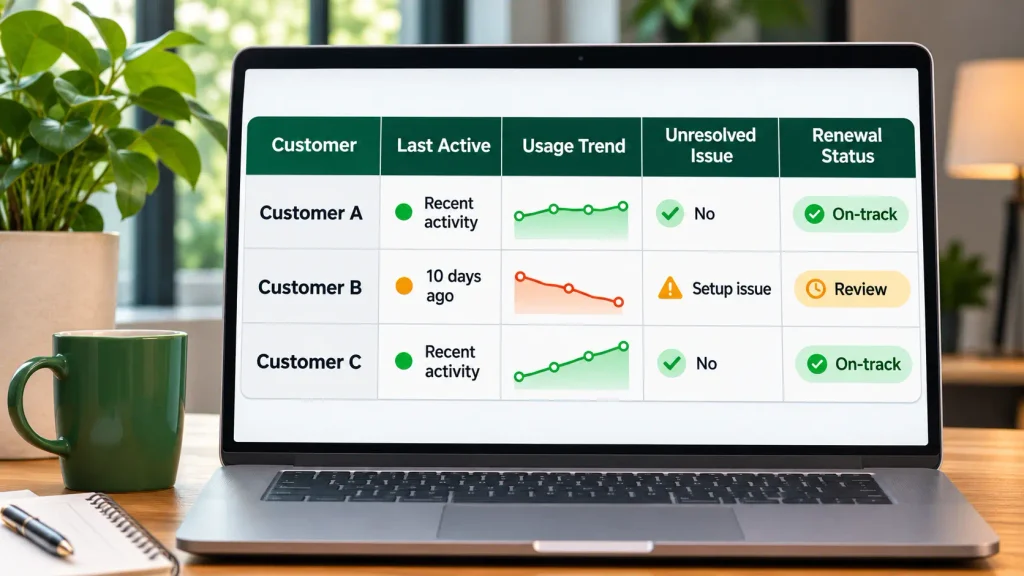
In this example, Customer B shows the clearest risk signals, so that’s the first call to make. Assuming this customer normally uses the product several times a week, the 10-day gap deserves investigation. A customer who only logs in monthly would be a different story.
Track the metrics that matter
Pick one period and use it every time. Monthly works for most early-stage teams.
- Customer churn rate: customers from the starting customer base who cancelled during the period ÷ customers at the start of the period × 100.
- Revenue churn rate: MRR cancelled by the starting customer base during the period ÷ MRR at the start of the period × 100.
- Customer retention rate: starting customers who are still active at the end of the period ÷ starting customers × 100. New customers added during the period don’t count.
- Renewal rate: renewals completed ÷ renewals due × 100.
- Product adoption: the share of customers who used your key action (for Kitelane, sending a report) in the last 30 days.
Know how churn affects your break-even point
If your average revenue and contribution margin per customer stay the same, churn doesn’t change your break-even threshold. It slows how quickly you reach it, because lost customers need to be replaced. Our guide on the SaaS break-even point shows how to calculate your own.
Common SaaS Churn Warning Signs
Most trouble is visible before the cancellation. Falling usage, the same complaint raised twice and missed milestones are all worth a call.
For a detailed explanation, see our upcoming guide on SaaS Churn Warning Signs.
Why SaaS Customers Cancel
The reasons usually fall into a few groups: the product doesn’t match what the customer needed, the price feels too high for the value, a key capability is missing, or the customer’s priorities changed.
Explore our upcoming guide on Why SaaS Customers Cancel for a detailed breakdown.
A 30-Day Churn Prevention Plan for the Founder
The 30-day timeline above follows a new customer. This plan is different. It’s your own monthly routine for the whole customer base, and you can start it with the customers you already have.
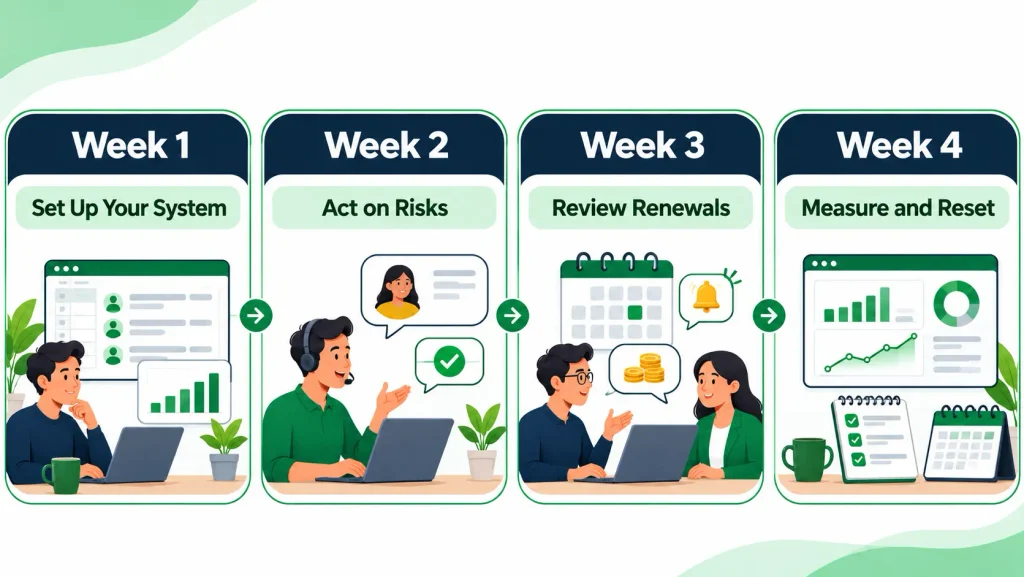
Week 1: Set up your system
Build the tracker. Choose the two or three usage signals you’ll watch and the first result you want every customer to reach.
Then write down each customer’s goal in one line.
Week 2: Act on the biggest risks
Call the customers your tracker flags. Review your complaint list and fix the problem that appears most often.
Week 3: Look ahead to renewals
List the renewals coming up. Read any price-related comments from customers.
Then prepare a renewal conversation for each account that is due soon.
Week 4: Measure and reset
Calculate your monthly customer churn, revenue churn and customer retention rate. Compare them with last month.
Write down the risks you haven’t solved, and choose next month’s priorities.
Frequently Asked Questions
How can startups prevent SaaS customer churn?
Start with the first 30 days. Learn what each customer expects, help them reach a first result quickly, and check in on a schedule. Then watch usage weekly and fix the problems that repeat.
What is a good SaaS churn rate?
There isn’t one number that fits every company. It depends on your price, customer size and contract length, so a rate that’s fine for one product can be a problem for another.
A more useful comparison is your own trend. Is your monthly customer churn rate falling over time? Also look at revenue churn, because losing one large customer can hurt more than losing two small ones.
Want to see your own numbers? Use our free Churn and Retention Calculator to work out your customer churn, revenue churn and retention rate in a few minutes. Get the Churn and Retention Calculator →
How often should SaaS founders check customer retention?
Weekly is a good rhythm for a small customer base. A quick scan of usage and open issues takes less time than one support call, and it catches problems while they’re still small. Review churn and retention rates monthly.
Can a SaaS startup reduce churn without a customer success team?
Yes. At this stage, the founder’s attention is the customer success program. A tracker, a fixed check-in schedule and a habit of fixing repeated problems cover most of what a small team needs.
How many customers should a startup track manually?
There’s no fixed number. A practical rule is to track every customer by hand until reviewing them takes more than an hour or two a week. After that, start using product data and tools to flag the accounts that need you.
Conclusion
Customers stay when your product keeps doing what they bought it to do. Churn prevention is mostly the habit of checking that this is still true.
You don’t need a big system. You need a list of your customers, a regular time to review it, and the discipline to call the ones who are slipping.
Here’s your first step: open a spreadsheet this week and add your first 10 customers. Write down each one’s goal, their last activity and anything unresolved. You’ll know who needs a call before the day is over.
Sources
- Casey Armstrong, “SaaS Churn: 9 Case Studies That Will Help You Make More Money,” CXL (published Aug 21, 2017; updated Mar 9, 2023): https://cxl.com/blog/saas-churn/. This is the source for Groove’s 4.5% monthly churn, the first-session and login figures, the email response rates and the 71% reduction described in the case study. CXL credits Groove’s own post on Red Flag Metrics, originally published on the Kissmetrics blog. We did not access that original post, so the figures here rely on CXL’s account.
- “Strategies for Reducing Churn,” Copper: https://copper.com/resources/strategies-for-reducing-churn. Used to cross-check Groove’s 4.5% monthly churn and the 71% figure. It is also a secondary retelling, not Groove’s own report.
- Kitelane is a fictional company created for this article. All Kitelane figures and the retention tracker table are illustrative.