
How to Build a Customer Referral Process for Early-Stage SaaS

Most early-stage SaaS founders treat referrals like a feature. They add a “Refer a friend” button, wait, and wonder why nothing happens.
Here’s the straight answer. A referral process is not a button. It’s a decision about who you ask, when you ask, what you say, how you capture the introduction, and how you track what happens next.
A practical customer referral process starts with a repeatable customer journey, not with a referral link or reward alone.
This guide shows you how to build that process from scratch. No expensive software. No 20-metric dashboards. Just a system you can start testing this week.
What Is a Customer Referral Process?
A customer referral process is the set of steps that turns a happy customer into a qualified conversation with a new prospect.
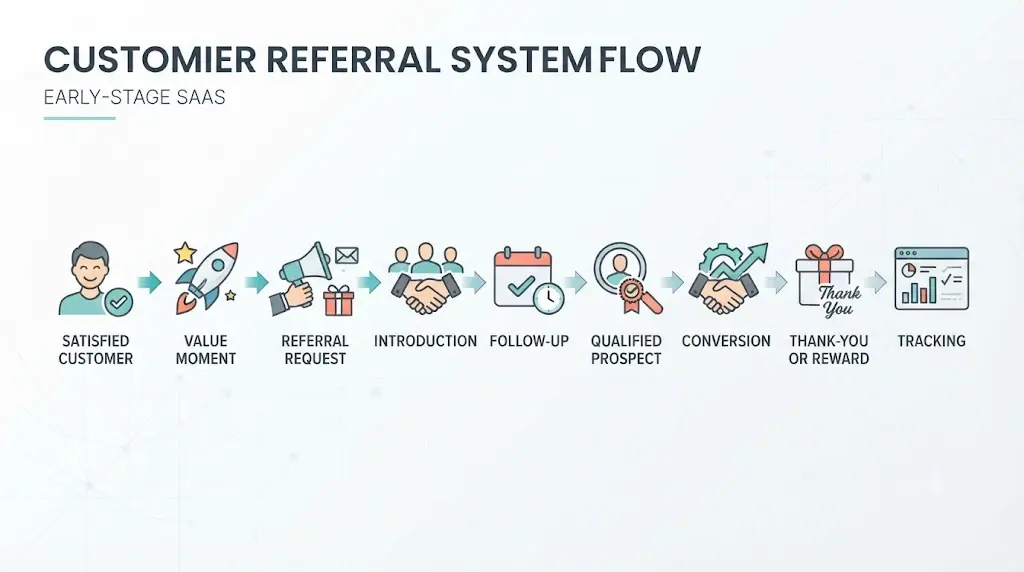
It looks like this:
Satisfied customer → value moment → referral request → introduction → follow-up → qualified prospect → conversion → thank-you or reward → tracking
That sequence is the core of a customer referral system. Each step makes the next referral easier to generate, track, and improve.
A referral program is the public-facing offer: the link, the reward, the page. A referral process is what happens behind it. For an early-stage SaaS, the process comes first. A formal referral program can come later, once you know what works.
When Should an Early-Stage SaaS Ask for Referrals?
Timing decides a lot. Ask too early and you sound pushy. Ask at the right moment and customers are far more likely to feel glad to help.
After the Customer Reaches a Real Outcome
Don’t ask right after signup. Ask after the customer gets a result they care about.
That could be a first report delivered, a workflow automated, or hours saved. When they can describe the win in their own words, they can describe you to someone else.
After a Positive Feedback Moment
A thank-you email. A warm reply to a check-in. A message saying “this is working well for us.”
A positive customer comment, strong product feedback, or a high-satisfaction response can be a useful referral signal. Your ask is just the next small step.
After Renewal or Repeat Usage
A renewal or consistent product usage can be a useful signal that the customer is getting ongoing value. Still, weigh it alongside their feedback, product usage, and support history before you ask.
When Not to Ask for a Referral
Skip the ask if the customer:
- Has an open support ticket
- Is still stuck in onboarding
- Recently complained about a bug or a missing feature
- Hasn’t used the product in weeks
A badly timed ask can cost you more than a missed referral. It can cost you trust.
How to Design the Customer Referral Process
You don’t need a big plan. You need six clear decisions. Make them in this order.
Define the Customer You Want Referred
Be specific. “Other startups” is not a profile. “Seed-stage B2B SaaS founders with a team under 10 who run outbound sales” is.
The clearer your picture, the easier it is for a customer to think of the right person.
Decide What Counts as a Qualified Referral
Not every introduction is worth your time. Write down what “qualified” means before the first referral arrives.
For example: the person fits your target profile, has the problem you solve, and is open to a call. Anything that doesn’t meet your criteria can still be a lead, but it shouldn’t be counted as a qualified referral.
Choose the Referral Trigger
Pick one trigger to start. Maybe it’s “30 days after a customer hits their first milestone.” Maybe it’s “right after a positive reply to a check-in.”
One trigger you actually follow beats five you forget.
Decide Whether You Need an Incentive
Many early-stage founders get this backwards. They design the reward first and the process second.
Start by asking whether your best customers would refer you without a reward. Sometimes they will, if you ask well. We cover incentives in detail below.
Make the Referral Action Easy
Make the referral action quick enough that the customer can complete it without leaving the conversation or figuring out a complicated process.
A short email they can forward works well. So does a two-line message they can paste into LinkedIn. Avoid sending them to a long form.
Decide How You Will Track Each Referral
If you can’t say who referred whom, you can’t thank them, reward them, or learn from the result.
Pick a tracking method before you make your first ask. A shared sheet is enough.
Create a Simple Referral Workflow
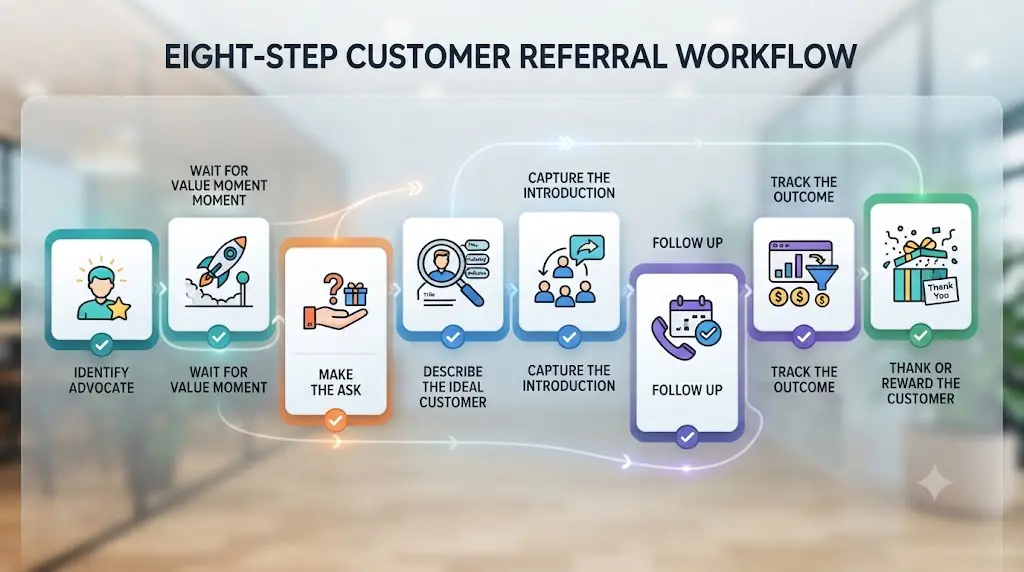
The process defines the decisions you need to make; the workflow turns those decisions into repeatable actions. Here’s a referral workflow you can copy. It has eight steps and works for solo founders and small teams alike.
- Identify the advocate. Pick a customer who is happy, active, and well-connected.
- Wait for the value moment. Don’t rush this step.
- Make the ask. Keep it personal and short.
- Describe who to think about. Give them a profile, not a vague request.
- Capture the introduction. Offer to write the intro email for them.
- Follow up fast. Reach out soon after the introduction, while it’s still fresh.
- Track the outcome. Log it in your sheet.
- Thank or reward the customer. Close the loop, even if the deal doesn’t close.
Step 8 gets skipped most often. It shouldn’t. A customer who never hears what happened is less likely to refer again.
For an additional reference on how SaaS referral programs are structured and run over time, see this guide to SaaS referral program design from Referral Rock.
How to Ask a SaaS Customer for a Referral
Asking feels awkward. It gets easier when you know what to say. Here are the four pieces of a good referral script.
The Simple Referral Ask
Keep it warm and direct. Here’s an example you can adapt:
“Hi Priya, glad the new reporting setup is saving your team time. Quick question: do you know one or two other founders who struggle with the same manual reporting? If so, I’d love an intro. Happy to write a short note you can forward.”
It’s short. It names a real result. It makes the next step easy.
Give the Customer a Clear Description of Who to Refer
Don’t make them guess. Say who you help best.
“Founders at B2B SaaS companies with 5 to 20 employees who are still doing customer onboarding by hand.” Now they can picture a name.
Ask for an Introduction, Not “Share This”
“Share this with your network” asks a customer to do marketing for you. “Can you introduce me to one person?” asks for a small, human favor.
Make Saying No Easy
Add one line: “No pressure at all if nobody comes to mind.”
It’s small, but it protects the relationship.
Still trying to reach your first 100 customers? See our practical guide to getting your first 100 customers without paid ads.
Should You Offer an Incentive?
Maybe. Not always. A customer referral incentive program only helps if the basics already work.
When Account Credit Makes Sense
For subscription SaaS, account credit can be a simple option because the reward stays connected to the product.
When Cash Rewards Make Sense
Cash can work for higher-priced B2B plans, where one new customer is worth a lot. Pay for results that matter, such as a paid conversion, not just a click or a signup.
One-Sided vs. Two-Sided Incentives
A one-sided reward goes only to the referrer. A two-sided reward goes to both people.
Two-sided rewards often feel fairer, because the new customer gets something too. But they cost more. Start with the simplest version and see how people respond.
When Not to Offer a Reward
Skip the reward when:
- You have only a handful of happy customers
- Your churn is still high
- Your customers are close contacts who would help anyway
Sometimes a personal thank-you note or an early look at a new feature works better than money.
How to Track Customer Referrals Without Expensive Software
You don’t need a tool on day one. You need a habit.
Start With a Spreadsheet
Open a Google Sheet. Share it with your team. Update it every time a referral comes in.
You can build the first version in Google Sheets. At low referral volume, that is usually enough.
What to Track
Keep the columns simple:
| Field | Why it matters |
|---|---|
| Referrer | Who made the introduction |
| Referred prospect | Who was introduced |
| Date | When the referral happened |
| Source | Where the referral came from (email, call, chat) |
| Status | New, contacted, qualified, or won |
| Revenue | Actual value of the deal |
| Reward | What you gave the referrer |
| Notes | Context you’ll want later |

What Metrics Should You Track?
Keep this list short. For an early-stage SaaS, these five metrics are a useful starting point.
Referral Rate
Of the customers you asked, how many gave you at least one introduction? This tells you whether your ask and timing work.
Qualified Referral Rate
Of the introductions you got, how many matched your target profile? This tells you whether you described the right person.
Referral-to-Customer Conversion
Of the qualified referrals, how many became paying customers? This is the number that shows quality, and it tells you whether your follow-up and qualification criteria are working.
Revenue From Referrals
Add up the revenue from referred customers. Compare it with your other channels. Over time, you’ll see whether referrals bring better accounts, and which kinds of customers to ask first.
Cost per Referred Customer
Add up rewards, tools, and the time you spent. Divide by the number of customers won. Early on, an honest estimate is enough. It tells you whether your incentive and effort are worth continuing.
Common Referral Process Mistakes SaaS Founders Make
Most referral efforts fail for ordinary reasons. Watch for these:
- Asking right after signup. The customer hasn’t seen value yet.
- Asking every customer. Pick the happy ones.
- Making customers figure out who to refer. Give them a profile.
- Using a long, complicated form. Every extra field adds friction.
- Rewarding clicks instead of outcomes. Pay for qualified results.
- Automating too early. Tools can’t fix a process you haven’t tested.
- Ignoring referral quality. More referrals aren’t better if they never buy.
- Scaling before retention is healthy. If customers are leaving, referrals will mostly bring in more people who leave.
A 30-Day Customer Referral Process
3 principles to remember before you launch
- Ask after value.
- Make the introduction easy.
- Reward meaningful outcomes.
Start with one simple incentive or recognition method and test it before adding more complexity.
Don’t launch a “program.” Test a process. Here’s a simple month:
| Week | Action |
|---|---|
| Week 1 | Identify a small group of customers who have clearly experienced value |
| Week 2 | Find each customer’s referral moment and write your ask |
| Week 3 | Personally request referrals, one by one |
| Week 4 | Review results, log everything, and improve the ask |
For example, you might start with 10 to 20 customers. Your numbers may differ, and that’s fine.
At the end of the month, you’ll know three things: who is willing to refer, what language works, and where the process breaks.
That’s more useful than a polished program no one has tested.
Still working on your first few SaaS customers? See our guide to getting your first 10 B2B SaaS customers.
When Should You Automate Your Referral Process?
Not yet, probably. But there’s a point where it makes sense. Tools can’t fix a process you haven’t tested.
Signs Manual Tracking Is Enough
- You get a few referrals each month
- You know every referrer personally
- You can send thank-you notes yourself
Signs You Need Referral Software
- Referrals arrive faster than you can log them
- Rewards are paid late or forgotten
- Referrers keep asking for status updates
- Your team can’t tell which referral came from whom
What to Automate First
Start with the repetitive parts: logging new referrals, sending status updates, and delivering rewards. Keep the personal ask and the follow-up human for as long as you can.
Frequently Asked Questions
What is a customer referral process?
It’s a repeatable set of steps that turns a satisfied customer into a qualified introduction, from the ask to the tracked result.
How do SaaS companies get customer referrals?
Usually with a personal ask after the customer reaches a real outcome. Give them a clear profile of who to refer and make the introduction easy.
When should you ask a SaaS customer for a referral?
After a clear win, a positive feedback moment, or a renewal. Avoid asking during onboarding, after a complaint, or while a support issue is open.
Should an early-stage SaaS offer referral incentives?
Not always. Start by asking your best customers directly. If you add a reward, keep it simple and tie it to qualified results, not clicks.
How do you track customer referrals?
Use a shared spreadsheet at first. Record the referrer, the referred prospect, the date, the status, the revenue, and the reward.
Do you need referral software to start?
No. Software helps once volume grows, but a spreadsheet and a clear process are enough to test whether referrals work for your product.
What is the difference between a referral program and a referral process?
A program is the public offer: the link, the reward, the page. A process is the internal system for who to ask, when to ask, and how to follow through.
Conclusion
Don’t start with referral software. Start with a repeatable customer referral process.
Pick customers who have clearly seen value. Ask at the right moment. Describe who you want to meet. Track every introduction. Thank people properly.
Do that for 30 days and you’ll learn more than any tool can teach you.
Ready to test the process? Pick a few customers who have clearly seen value, write your first referral ask, and start tracking the results.