
How to Calculate SaaS Break-Even Point: 5 Simple Steps

Your MRR chart is climbing. New signups hit your inbox every week. And yet, at the end of the month, your bank balance tells a different story.
This is the strange middle stage almost every SaaS founder lives through — growing revenue, but no real profit. The fix isn’t more hustle. It’s math. Specifically, it’s knowing your SaaS break-even point: the exact number of paying customers, and the exact MRR, you need to stop losing money every month.
In this guide, you’ll calculate three things:
- The number of paying customers you need
- Your break-even MRR
- A realistic estimate of how long it’ll take to get there
Let’s get into it.
What Is the Break-Even Point for a SaaS Startup?
Break-even is the point where your total monthly revenue equals your total monthly costs. Not a cent more, not a cent less. Profit and loss both sit at zero.
For a traditional business — say, a bakery — break-even is fairly linear: sell enough loaves of bread to cover the rent and ingredients. SaaS is messier. Revenue arrives as small, recurring slices (subscriptions), and costs stack up per customer in ways that aren’t always obvious — a support ticket here, a spike in API usage there.
The traditional break-even formula still applies to SaaS, but it must be adapted around recurring revenue, contribution margin, and customer-level costs.
The SaaS Break-Even Point Formula
Break-Even Customers = Monthly Fixed Costs ÷ Contribution Margin per Customer

Contribution Margin per Customer = ARPA − Variable Cost per Customer

Break-Even MRR = Break-Even Customers × ARPA
Three formulas, one goal: find the customer count where your revenue finally catches up to your costs.
How to Calculate the SaaS Break-Even Point in 5 Steps

Step 1: Calculate Your Monthly Fixed Costs
Fixed costs are what you pay regardless of how many customers you have. For most early-stage SaaS teams, this list includes:
- Employee and contractor salaries
- Founder salary (yes, include it — this trips up almost everyone)
- Office or remote-work stipends
- Base software subscriptions
- Legal and accounting fees
- Minimum cloud infrastructure costs (the baseline, not usage spikes)
- Recurring administrative expenses
One rule to burn into memory: don’t mix one-time startup costs (like your initial MVP build) into monthly operating costs. Break-even is a monthly math problem, not a lifetime-spend problem.
Step 2: Determine Your Average Revenue per Account (ARPA)
ARPA = Total MRR ÷ Number of Paying Customers
Example:
- Monthly recurring revenue: $12,000
- Paying customers: 200
- ARPA: $60
If you run multiple pricing plans, don’t just average the sticker prices — use a weighted average based on how many customers sit on each plan. A $200/month enterprise tier with five customers shouldn’t be weighted the same as a $15/month starter tier with two hundred.
Step 3: Calculate the Variable Cost per Customer
These are the costs that grow as your customer base grows:
- Usage-based hosting
- Third-party API charges
- Payment-processing fees
- Customer onboarding
- Usage-based customer support
- Email, storage, or communication costs
The trick here is separating genuinely usage-based costs from general business expenses. Your office Wi-Fi bill doesn’t change because you added ten customers. Your AWS bill probably does.
Step 4: Find the Contribution Margin per Customer
Contribution Margin per Customer = ARPA − Variable Cost per Customer

Contribution Margin % = (Contribution Margin per Customer ÷ ARPA) × 100
| Metric | Amount |
|---|---|
| ARPA | $60 |
| Variable cost per customer | $12 |
| Contribution margin per customer | $48 |
| Contribution margin percentage | 80% |
An 80% contribution margin is healthy for most SaaS products. If yours is closer to 40-50%, it’s worth a closer look at Step 3 before moving forward — your break-even number will otherwise look intimidatingly high.
Step 5: Calculate Break-Even Customers and MRR
Example:
- Monthly fixed costs: $15,000
- ARPA: $60
- Variable cost per customer: $12
- Contribution margin: $48
Break-Even Customers = $15,000 ÷ $48 = 312.5
Since half a customer isn’t a real thing, round up to 313 paying customers.
Break-Even MRR = 313 × $60 = $18,780
That’s it. You now know exactly what your business needs to hit to stop bleeding cash every month.
Complete SaaS Break-Even Calculation Example

Let’s walk through a fuller picture with a fictional startup, “Loopwise,” a project-tracking tool for small agencies.
Loopwise’s numbers:
| Plan | Price per Month | Customers |
|---|---|---|
| Starter | $29 | 120 |
| Growth | $79 | 60 |
| Team | $149 | 20 |
- Total customers: 200
- Total MRR: $11,200
- Weighted ARPA: $56
- Monthly fixed costs: $14,000 (salaries, tools, base hosting)
- Variable cost per customer: ~$9 (hosting, support, payment fees)
- Contribution margin: $47 per customer
Break-even math:
Break-Even Customers = $14,000 ÷ $47 = 298 customers
Break-Even MRR = 298 × $56 = $16,688
Loopwise currently has 200 customers generating $11,200. To break even, it needs 98 more paying customers and roughly $5,488 more in MRR. That gap is the actual, honest number the founders need to plan around — not a vague “we’ll get there eventually.”
How Long Will Your SaaS Take to Break Even?
Knowing the target customer count is useful. Knowing when you’ll hit it is what actually helps you plan hiring, runway, and fundraising decisions.
You’ll need:
- Current paying customers
- Monthly new customers
- Monthly churned customers
- Net customer growth (new minus churned)
- Break-even customer target
Estimated Months = Remaining Customers Needed ÷ Monthly Net Customer Growth
A quick disclaimer worth repeating to yourself often: churn, pricing changes, and cost shifts will move this timeline. Treat it as a working estimate, not a guarantee.
Months-to-Break-Even Example
- Current customers: 190
- Break-even target: 313
- Net customer growth: 15 per month
- Remaining customers needed: 123
- Estimated time: ~9 months
How Churn and CAC Affect SaaS Break-Even
Customer Churn
Churn quietly eats into your net customer growth. Every customer you lose isn’t just a lost sale — it’s revenue a replacement customer now has to re-earn before any real progress happens. High churn doesn’t usually move your break-even target, but it can seriously stretch out the timeline to get there.
Customer Acquisition Cost (CAC)
Whether to treat CAC as a fixed or variable cost depends on what question you’re answering. Sales and marketing spend contributes to your fixed-cost base in a standard break-even calculation — but that’s different from asking how long it takes to earn back what you spent acquiring a single customer. That second question is CAC payback period, and it’s a separate (equally important) metric — closely tied to how you calculate your startup valuation, since acquisition efficiency is one of the first things investors scrutinize.
Pricing and Expansion Revenue
A higher ARPA directly lowers the number of customers you need to break even. This is why upsells and expansion revenue matter so much — growing revenue from existing customers is often a faster path to break-even than only chasing new signups. On the flip side, heavy discounting quietly shrinks your contribution margin and pushes your break-even target further away, even while your customer count grows.
SaaS Break-Even Point vs. CAC Payback Period
These two get confused constantly. They’re not the same thing.
| Metric | What It Measures |
|---|---|
| SaaS break-even point | Revenue or customer level needed to cover the company’s total costs |
| CAC payback period | Time required to recover the cost of acquiring one customer |
| Profitability | The point at which total revenue exceeds total expenses |
| Cash-flow break-even | The point at which actual cash inflows cover actual cash outflows |
A company can be at break-even on paper while still burning cash acquiring new customers whose payback hasn’t landed yet. Knowing the difference keeps you from celebrating (or panicking) at the wrong number.
How to Lower Your SaaS Break-Even Point
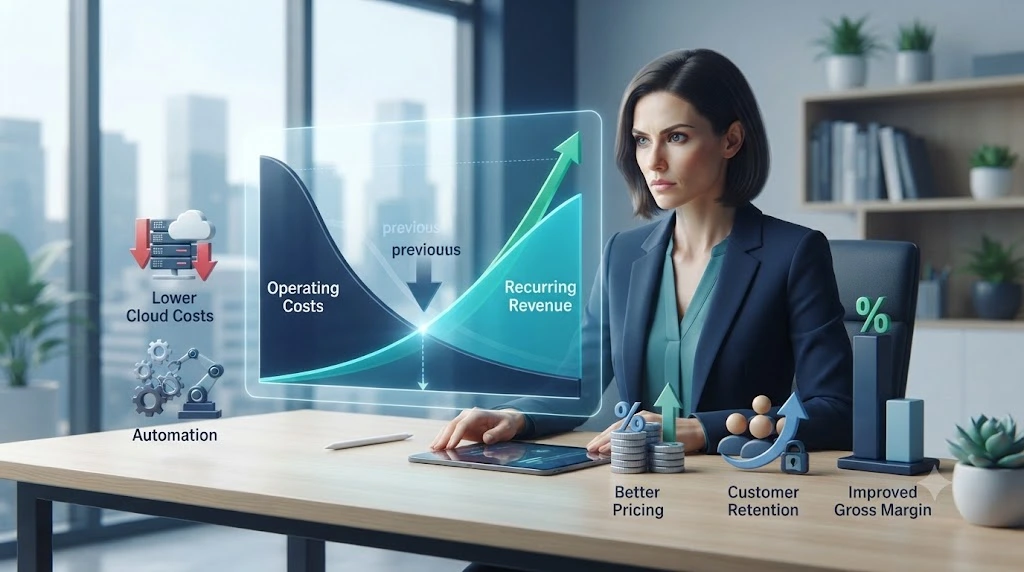
1. Increase ARPA Without Overpricing
Better plan packaging, usage-based add-ons, premium features, and genuine expansion revenue can raise ARPA without alienating your existing customer base.
2. Reduce Variable Costs per Customer
Optimize your infrastructure spend, renegotiate or audit API costs, and keep a close eye on support cost per ticket. Many teams also automate repetitive startup operations — onboarding emails, ticket triage, usage reporting — which quietly lowers the per-customer cost that’s dragging on your contribution margin.
3. Reduce Unnecessary Fixed Costs
Cancel tools nobody uses. Delay hiring that isn’t tied to a clear revenue outcome. Review every contractor and software line item quarterly, not yearly.
4. Improve Customer Retention
Retention doesn’t directly shrink your break-even customer count — but it dramatically speeds up how fast you reach it, and it keeps your recurring revenue stable enough to trust your own forecasts.
5. Improve Gross Margin
A higher gross margin means more of every dollar in revenue flows straight into your contribution margin — which lowers both your break-even customer count and your break-even MRR.
Real Case Study: Buffer’s Road Back to Break-Even
Buffer, the social media scheduling tool, is one of the most publicly documented break-even turnarounds in SaaS — mostly because its founders have been unusually open about the numbers, across two very different moments in the company’s history.
2016: the layoff that forced the reset. Rapid hiring had outpaced revenue growth, and CEO Joel Gascoigne laid out the full financial picture in Buffer’s 2016 layoff announcement — 10 employees, about 11% of the team, let go, alongside co-founder salary cuts and a canceled team retreat. The combined moves were aimed at one goal: bring monthly costs back in line with revenue without raising more funding.
Buffer’s founders have since written that the company returned to profitability and went on to post eighteen consecutive profitable quarters, a track record the team documented in its own 10-year retrospective.
2024: what break-even actually looks like month to month. Years later, in Buffer’s 2024 profitability update, Gascoigne shared that the business essentially broke even across the first ten months of that year, then generated the bulk of its annual profit in November and December alone. It’s a useful reminder that break-even rarely moves in a smooth, gradual line — it can look flat for most of the year before a shift in strategy or seasonality tips it into profit.
The lesson for early-stage founders isn’t “avoid hiring.” It’s this: fixed costs—often led by salaries—are one of the biggest levers in your break-even formula, and they’re worth revisiting on a real schedule — not just when the bank balance forces the conversation.
Common SaaS Break-Even Calculation Mistakes
- Mistaking total revenue for contribution margin
- Excluding founder salary from fixed costs
- Forgetting to convert annual expenses into monthly figures
- Leaving out usage-based API and hosting costs
- Treating one-time costs as recurring costs
- Ignoring churn in the months-to-break-even forecast
- Rounding customer numbers down instead of up
- Confusing cash-flow break-even with accounting break-even
SaaS Break-Even Calculator Template
Fill this in with your own numbers:
| Input | Your Amount |
|---|---|
| Monthly fixed costs | $ |
| ARPA | $ |
| Variable cost per customer | $ |
| Contribution margin per customer | $ |
| Break-even customers | |
| Break-even MRR | $ |
| Current customers | |
| Net new customers per month | |
| Estimated months to break even |
Bookmark this table. Revisit it every time your pricing, costs, or team size changes.
Frequently Asked Questions
What is a good break-even point for a SaaS startup?
There’s no universal number — it depends on your fixed costs and contribution margin. What matters more than the absolute figure is whether your current growth rate gets you there within a runway you can actually afford.
How do you calculate break-even MRR?
Multiply your break-even customer count by your ARPA (average revenue per account). Break-even customers, in turn, come from dividing monthly fixed costs by your contribution margin per customer.
How many customers does a SaaS startup need to break even?
It varies by business, but you can find your exact number with one formula: Monthly Fixed Costs ÷ Contribution Margin per Customer.
Should CAC be included in a SaaS break-even calculation?
It depends on the question you’re asking. For a standard break-even calculation, sales and marketing spend is usually treated as a fixed cost. For understanding acquisition efficiency specifically, use CAC payback period instead.
Does churn change the SaaS break-even point?
Churn doesn’t change your break-even target, but it slows down your net customer growth — which stretches out how long it takes to actually reach that target.
Is break-even the same as profitability?
Not quite. Break-even means revenue equals costs — zero profit, zero loss. Profitability means revenue has moved past that line and stayed there.
Can a SaaS company have positive cash flow before breaking even?
Yes. Annual prepayments, upfront invoicing, or delayed vendor payments can create positive cash flow even while the company is technically still below its accounting break-even point. This is why cash-flow break-even and accounting break-even are tracked separately.
Final Thoughts
Your SaaS break-even point isn’t just a finance-team exercise — it’s the number that tells you whether “we’re growing” actually means “we’re getting healthier.” Calculate your fixed costs, your ARPA, and your contribution margin honestly. Track your break-even customers, your break-even MRR, and your realistic timeline side by side.
And revisit the calculation every quarter, or any time your pricing or costs shift. The founders who treat break-even as a living number — not a one-time spreadsheet exercise — are the ones who stop being surprised by their own bank balance.
Want help estimating how much runway you actually need before you hit break-even? Check out our guide on how much funding a startup needs to plan your next 12-18 months with real numbers, not guesswork.