
Weekly Planning Routine: 7 Steps Startup Founders Can Follow

It’s Monday morning. You sit down with a plan for the week.
By noon, a customer issue needs attention, a developer is waiting on a decision, and an investor requests a call. Your original schedule no longer fits.
A weekly planning routine won’t prevent every surprise. It gives you a practical way to choose what matters, organize the work, and adjust when the week changes.
This guide walks through seven steps, a copyable planning template, and common mistakes to avoid.
Recommended rhythm: Your weekly planning routine works best in two parts. Draft next week’s plan on Friday, then use 10–15 minutes on Monday to review last week’s blockers and confirm the plan, plus a short team alignment (Step 5). This keeps Friday’s preparation from becoming a fixed commitment before new information arrives.
Time needed: Your weekly planning routine takes about 1 hour on Friday, 15–30 minutes on Monday, and 10–15 minutes on Wednesday. That is roughly 1.5–2 hours a week.
1. Monday Quick Look-Back (10–15 Minutes)
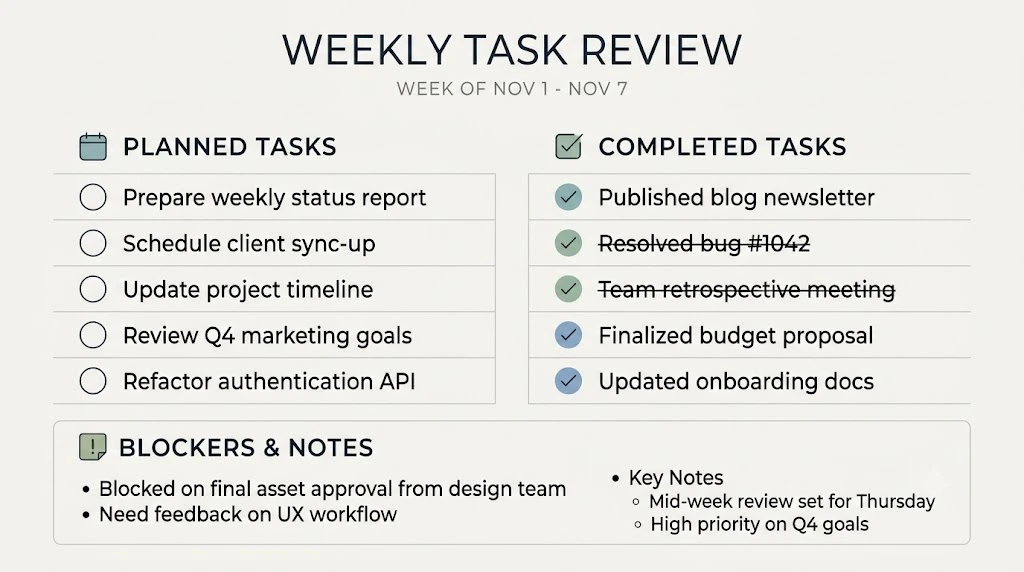
On Monday, take 10–15 minutes to look back at the previous week. This is the first part of your weekly planning routine: a quick operational check to identify unfinished work and blockers that could affect this week’s plan. It is not the full outcome review—that happens on Friday in Step 7.
Compare Planned and Completed Work
Open last week’s plan and compare it with what actually happened. Mark each outcome or task as completed, partly completed, or not started.
For unfinished work, ask: What got in the way?
Look for Recurring Obstacles
Common causes include:
- Unexpected work that displaced planned tasks
- Dependencies or approvals that arrived late
- Priorities that were unclear
- Estimates or deadlines that didn’t match the work
Example: A founder planned five tasks and completed two. The review shows that a customer issue took a day and two tasks were waiting for design input. The next plan can account for support work and request design input earlier.
2. Choose Your Top 1–3 Business Priorities (10 Minutes)
Steps 2–4 are part of Friday’s draft in your weekly planning routine. Choose one to three outcomes that deserve attention in the coming week. The right number depends on your role and workload. Essential operational work, hiring, compliance, or urgent customer needs may also require time; keep them visible rather than forcing everything into the priority count.
Choose Priorities Based on Business Impact
Consider which outcomes matter most right now:
- Revenue or customer acquisition
- Product progress
- Customer retention
- Critical operational issues
For help connecting team goals to measurable outcomes, read our guide to setting measurable startup goals.
Define the Outcome
A priority should describe a result, not just a topic. For each one, answer:
- What should be different by the end of the week?
- Why does it matter?
- What evidence will show progress?
Example: Replace “Work on marketing” with “Complete 10 qualified customer conversations.” The second statement describes an observable outcome.
If two priorities compete, our guide to making decisions as a solo founder can help you evaluate the trade-off.
3. Turn Priorities Into Actionable Tasks (10–15 Minutes)
A priority describes the result you want. Tasks describe the work that can move it forward.
Break Each Priority Into Manageable Steps
Split a large outcome into clear actions. The right task size depends on the project; aim for steps that are specific enough to start and review.
Assign Owners, Due Dates, and Dependencies
For each task, record:
- Owner: Who is responsible for moving it forward?
- Due date: When should it be completed or reviewed?
- Dependency: What person, approval, information, or tool is needed first?
Clear ownership helps prevent tasks from stalling, especially when several people contribute.
Example: For “Launch the new pricing page,” tasks might include collecting customer feedback, resolving priority bugs, updating the page, and preparing the launch email. Assign an owner and a realistic due date to each.
4. Build a Realistic Weekly Schedule (15–20 Minutes)
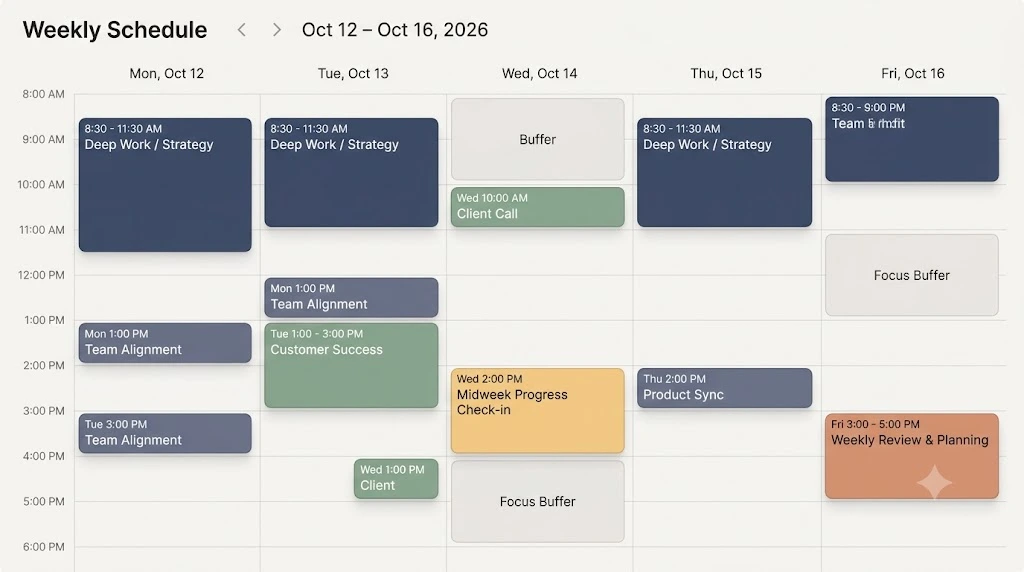
After choosing priorities and tasks on Friday, place the most important work on your calendar. Once your weekly planning routine has a place on the calendar, it is much easier to follow. Treat this as a draft; confirm or adjust it on Monday after your quick look-back.
Protect Focus Time
Reserve blocks for work that needs sustained attention, such as:
- Product strategy
- Customer research
- Important business decisions
If your calendar is already crowded, our guide to time management for solopreneurs may help you review how your time is allocated.
Group Meetings and Coordination
Where practical, group meetings together instead of spreading them across every day. Leave time to prepare and capture follow-ups.
Leave Room for Unplanned Work
Early-stage companies often face unexpected requests. Keep some time unscheduled so that one urgent issue doesn’t automatically displace the entire plan. The amount of buffer will depend on your role, team, and current workload.
Example schedule for a founder with a small team:
| Day | Morning | Afternoon |
|---|---|---|
| Monday | Look-back (10–15 min); confirm Friday’s draft; team alignment (5–15 min) | Customer calls and follow-ups |
| Tuesday | Focus work: product | Meetings, hiring, or sales calls |
| Wednesday | Focus work: customer research | Midweek check-in (10–15 min) and buffer |
| Thursday | Focus work: key decisions | Team coordination and buffer |
| Friday | Finish or review priority work | Outcome review and next-week draft (about 1 hour) |
5. Align Your Team Around Weekly Priorities (5–15 Minutes)
Your weekly planning routine is more useful when the people involved understand the intended outcomes and their responsibilities. Do this during Monday’s confirmation, before execution gets underway.
Working solo? Share your priorities with a co-founder, advisor, mentor, or accountability partner—or write a short commitment note for yourself if no one else is involved.
Share Priorities and Ownership
In a short Monday check-in, cover:
- The week’s intended outcomes
- Who owns each key task
- Dependencies or blockers that need attention
Allow 5–15 minutes, depending on team size and whether you meet live or share an async update.
Surface Dependencies Before Work Starts
Ask:
- Which tasks need input from another person?
- Are any approvals, decisions, or resources missing?
- What can be done now while waiting?
Raise likely blockers early so the team can address them before they delay execution.
If you need to free up founder capacity, see tasks startup founders can delegate.
6. Track Progress During the Week (10–15 Minutes on Wednesday)
A weekly planning routine is not a one-time activity. A brief check during execution helps you spot changes while there is still time to respond.
Run a Midweek Check-In
On Wednesday, review:
- Which outcomes or tasks are on track?
- Which items are delayed, and why?
- Have any dependencies changed?
- Does a priority or deadline need to be reconsidered?
Adjust Deliberately
Not every new request requires a complete reset. Decide what genuinely needs to change, what can wait, and what remains important.
Example: A key customer reports a serious issue on Wednesday. The founder handles it and moves a lower-impact task to next week. The other priorities remain in place because they are still relevant.
7. Friday Outcome Review and Next-Week Draft (About 1 Hour)
The Friday review is the anchor of a sustainable weekly planning routine. Set aside about an hour: 15–20 minutes to review business outcomes, then 35–45 minutes to draft next week’s plan using Steps 2–4. Step 1 was Monday’s quick look-back at unfinished work and blockers; this step is the fuller review of results, lessons, and carry-forward decisions.
Regular reviews are central to other productivity systems too. David Allen explains why in this episode on the GTD weekly review.
Review Outcomes, Not Just Tasks
Return to the outcomes you set for the week:
- Which outcomes did you achieve or make meaningful progress on?
- Which tasks were completed without producing the expected result?
- What did you learn that should affect next week’s plan?
Completing tasks is useful, but the business result matters too. If the result didn’t follow, review the assumptions or approach before simply adding more tasks.
Decide What Carries Forward
For unfinished work, record:
- Whether it is still important
- What prevented completion
- What needs to change next time
- Whether it belongs in next week’s plan
Then draft next week’s priorities, tasks, and schedule. On Monday, confirm or adjust that draft after the 10–15-minute look-back. Avoid moving every unfinished task forward automatically.
Weekly Planning Template for Startup Founders
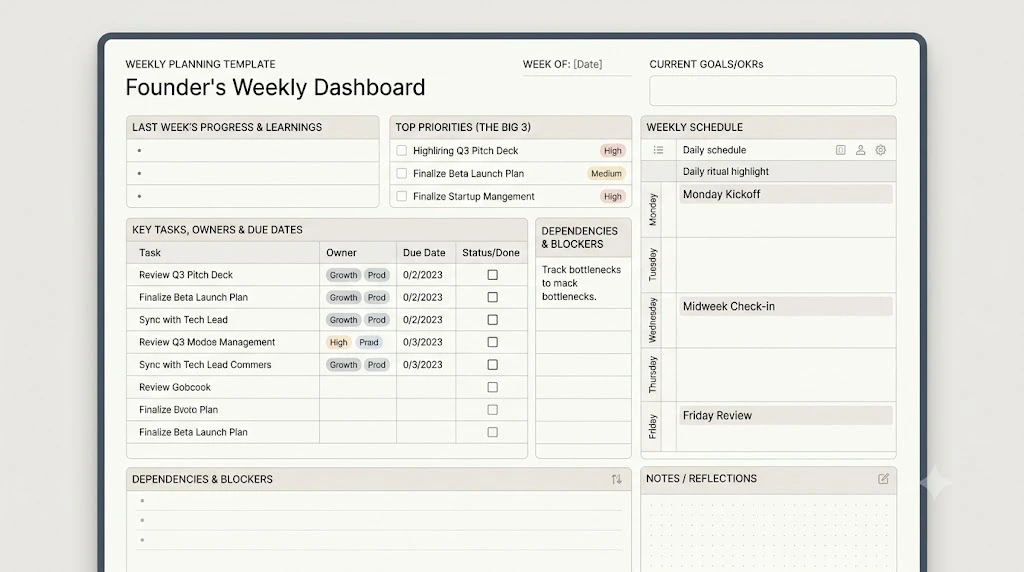
Copy this template into Notion, Google Docs, or a notebook to run your weekly planning routine. On Friday, complete the review and draft; on Monday, record any changes during confirmation.
| Planning item | What to write |
|---|---|
| Last week’s progress | Outcomes completed, partly completed, or missed |
| Lessons from last week | Obstacles, surprises, and changes to make |
| Weekly priorities | A small set of important business outcomes |
| Key tasks | Actions needed to move each outcome forward |
| Owners | Person responsible for each task |
| Due dates | Completion or review dates |
| Dependencies | Inputs, approvals, or decisions needed |
| Weekly schedule | Friday’s draft of focus blocks, meetings, and buffer time |
| Monday confirmation | Changes to Friday’s draft after checking new information |
| Midweek check-in | Progress, blockers, and any adjustments |
| Friday review | Outcomes, lessons, and carry-forward decisions |
Filled-in example (fictional)
This sample shows how a founder might turn priorities into tasks. The company, targets, and assignments below are fictional examples, not reported results.
| Weekly priority | Success measure by Friday | Task | Owner | Due |
|---|---|---|---|---|
| Learn why trial users stall | Complete 5 user conversations and summarize 3 recurring issues | Invite users; conduct calls; summarize patterns | Founder | Fri |
| Improve first-use experience | Publish a revised 3-step onboarding checklist | Draft checklist; review with 2 users; publish | Founder | Thu |
| Reduce support backlog | Resolve or respond to 10 oldest eligible tickets | Categorize tickets; answer or escalate | Founder | Wed |
For a solo founder, “owner” is still useful: write Founder or your own name. For a team, assign one accountable owner per task and list collaborators separately.
Common Weekly Planning Routine Mistakes Startup Founders Should Avoid
Use these quick fixes when your weekly planning routine starts to drift:
- Choosing too many priorities: Identify the outcomes that matter most this week; place smaller actions under them.
- Filling every calendar slot: Leave realistic room for unexpected work and transitions.
- Tracking tasks without defining outcomes: Write the result each priority is meant to produce.
- Ignoring dependencies: Identify people, approvals, and information needed before the week begins.
- Skipping the midweek review: Reserve a recurring check-in, then adjust only where needed.
- Carrying unfinished work forward automatically: Decide whether it is still important and what must change.
Frequently Asked Questions
How do startup founders plan their week?
A practical weekly planning routine is to review the previous week, choose a few outcomes, break them into tasks, schedule focus time, align the team, check progress midweek, and review results on Friday.
How many weekly priorities should a startup founder have?
Up to three can be a useful starting point for major outcomes. The right number depends on the founder’s responsibilities and current workload. Keep essential operational work visible rather than forcing every task into the priority count.
When should founders do weekly planning?
Draft the plan on Friday afternoon, while the week is fresh and lessons are easy to capture. Then spend a short Monday session reviewing blockers and confirming or adjusting the draft with any new information. Choose consistent times that fit your team and keep your weekly planning routine repeatable.
How do you create a weekly schedule as a startup founder?
Start by scheduling focus time for the week’s important outcomes. Add meetings and coordination next, then leave some unscheduled time for unexpected work. Adjust the plan to your actual responsibilities rather than copying a fixed calendar.
Your Next Step: Start Your Weekly Planning Routine This Friday
A weekly planning routine doesn’t need to be perfect. It needs to be repeatable and useful.
This Friday, set aside about an hour to review outcomes and draft next week’s plan. On Monday, use 10–15 minutes to check blockers and confirm it, plus a short team alignment. For help defining measurable outcomes, read our guide to setting startup goals. You can also review tasks startup founders can delegate when deciding how to make room for priority work.