How to Make Decisions as a Solo Founder: A Practical Framework

Pricing feels off. A customer wants a feature you haven’t planned. Ad spend is creeping up, and the final call is yours.
That’s the everyday reality of how to make decisions as a solo founder. You can ask mentors, customers and specialists for input. But the judgement, and the consequences, stay with you. And you rarely have all the facts.
This guide gives you a simple framework you can reuse. You’ll learn how to define a decision, separate facts from guesses, weigh risk, and move forward. You’ll also see what a real public case study from Amazon can teach a one-person business, and where its lessons stop applying.
Why Decision-Making Is Difficult for Solo Founders
Teams have their own decision problems. But a solo founder faces a specific gap: there’s often no built-in challenge or independent review.
Three things make it harder:
- Independent judgement. Important decisions need your own reasoning, even when you’ve collected advice.
- Conflicting advice. One mentor says raise prices. A founder group says wait. A forum post says something else again.
- Two kinds of cost. A wrong decision can cost money or trust. A delayed decision costs momentum, and that cost is easy to overlook.
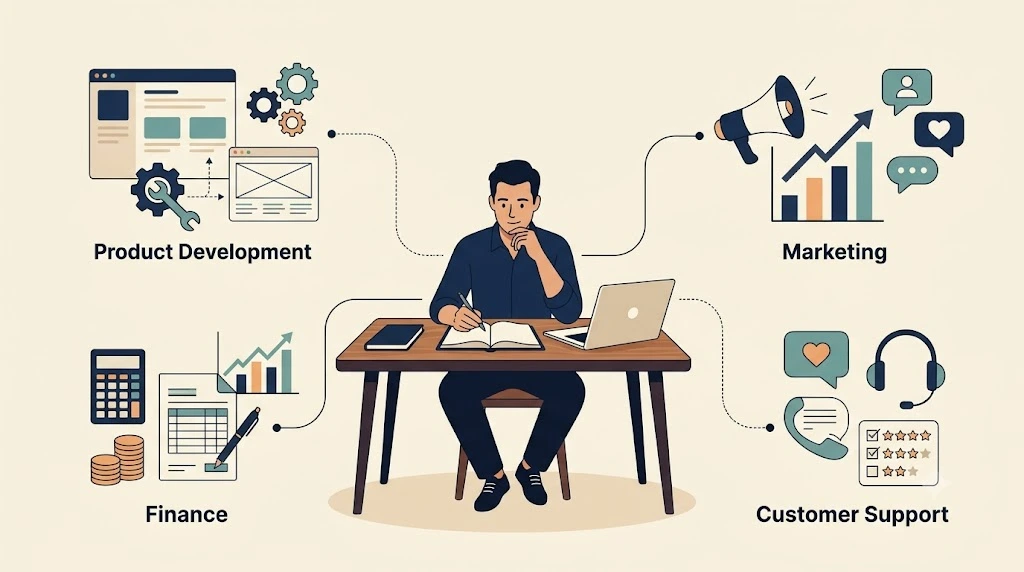
Workload plays a part too. When you’re covering product, marketing and support at once, you have less energy for careful thinking. Tired founders tend to rush decisions or avoid them. Protecting some thinking time for your biggest decisions is part of the job.
How to Make Decisions as a Solo Founder: A 5-Step Framework
Here are five steps you can reuse for pricing, features, spend and more.
Match the depth to the stakes. For a simple, low-risk choice, you can run through these steps in a few minutes. For a major decision, such as a big contract, a rebuild or a hire, each step deserves deeper analysis.
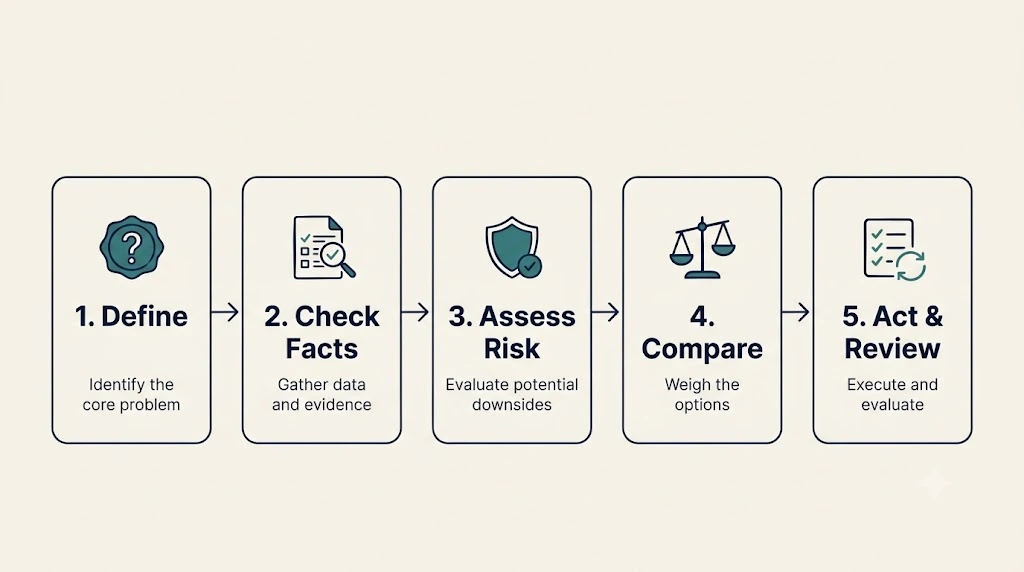
1. Define the Decision Clearly
Most poor decisions start with a vague question. “What should I do about marketing?” is a worry, not a decision.
Write it as one clear question. For example: “Should I move $300 a month from SEO to paid ads for the next 60 days?”
Then note:
- The outcome you want
- The date you need to decide by
A deadline keeps a decision from sitting open for weeks.
2. Separate Facts from Assumptions
Draw two columns. In one, list what you know. In the other, list what you believe.
“Three customers requested this feature” is a fact. “Enough customers will pay for it” is a hypothesis.
Next, ask: which missing piece of information could actually change my decision? Research that piece first. You don’t need to resolve every uncertainty.
Often, the missing piece is customer evidence. To judge how much is enough, see our guide on how to gather enough customer evidence before you decide.
3. Assess Risk and Reversibility
Reversibility matters, but it isn’t the only factor. Look at four things separately:
- Undo cost. How much time and money would it take to reverse this?
- Financial exposure. How much could you lose if it fails?
- Customer impact. Would a wrong call affect trust, service or existing users?
- Reversibility. Can you realistically go back?
A decision can be technically reversible and still risky. A pricing change may be easy to reverse, but customers who leave may not return.
Use small experiments to shrink the risk. Give high-cost or high-impact decisions more careful evaluation. We’ll look at one well-known approach to this in the case study below.
4. Compare Options and Trade-Offs
Put your options side by side. For each, note:
- The expected benefit
- The cost in money and time
- The downside if it fails
- The opportunity cost, meaning what you give up by choosing it
Then ask: which option gets me closest to the outcome I wrote in step one?
You aren’t looking for a perfect option. You’re looking for the best balance of upside and protection from the downside.
5. Decide, Act and Review
A decision isn’t complete until it has an action attached. Write down:
- The decision. One sentence.
- The next action. Something you can do this week.
- A success measure. Make it a number tied to your own baseline and the goal of the test. For example: “Trial-to-paid conversion stays above 2.5% for 30 days.” (This is only an illustration, not an industry benchmark. Set your own target from your current numbers and how much risk you can accept during the test.)
- A review trigger. A date, or a signal that tells you to look again.
If new evidence appears, adjust. Changing your mind after learning something is the point of a review.
How to Challenge Your Own Thinking Without a Cofounder
Alone, your opinion bounces around one head. It can start to sound right simply because you’ve heard it so often.
You can build in challenge without a partner:
- Look for disconfirming evidence. Search for the strongest case against your plan, and also for the strongest case for it. Searching only for counterarguments, or only for support, leaves you with selective evidence.
- Ask a specific question. Don’t ask a mentor, “What do you think?” Ask, “What would make you hesitate to raise prices now?”
- Prioritise customer behaviour. What customers do usually tells you more than what you hope they feel.
- Use AI for alternatives. Give it your plan and ask for objections, not approval. For example: “Here is my plan: [plan]. Give me the three strongest objections, and for each one, tell me what evidence would prove it right.” Then check every objection against real customer data. AI can surface weak points, but it shouldn’t be the final authority.
When a decision needs a skill you lack, ask a specialist a narrow question. You don’t need a long-term partner for one review.

How to Make Decisions With Limited Information
You will rarely have complete information. Waiting for it is a decision too.
Start with two definitions:
- The research question. What exactly do you need to find out?
- The decision-changing evidence. What result would make you choose differently?
If you can’t name evidence that would change your mind, more research won’t help yet.
Then match effort to risk:
- Lower risk: run a small test and learn from the result.
- Higher risk: research more, talk to more people and take more time.
Weigh the value of more research against the cost of waiting. Testing an idea before you build it is a good example. This guide shows how to validate a startup idea before building an MVP.
Case Study: How Amazon Approaches Fast Decisions
Amazon is not a solo business, and its situation is very different from yours. But Jeff Bezos’s 2016 letter to shareholders is a public source you can read yourself. It contains ideas worth adapting, carefully.
Not every decision needs the same process. Bezos describes many decisions as reversible “two-way doors.” For those, he argues a lightweight process is enough. For consequential, hard-to-undo decisions, the bar is higher. (His 2015 letter to shareholders covers this in more detail.)
A rule of thumb on information. He suggests that most decisions should probably be made with around 70% of the information you wish you had. Waiting for 90% often means moving too slowly, he argues. This is his own management principle, not a proven threshold for every startup. It also depends on being good at spotting and correcting mistakes quickly.
Disagree and commit. This is an Amazon team practice. When people disagree and there’s no consensus, someone can say, “I disagree, but I’ll commit.” The team then moves without having to win over every person first. Bezos gives an example from Amazon Studios, where he voiced doubts and then backed the team’s decision.
What a solo founder can adapt:
You don’t have a team to commit with you, so this idea doesn’t transfer exactly. A solo version looks like this instead:
- Challenge your assumptions.
- Record the risks you haven’t resolved.
- Commit to a reversible next step.
- Set a review date.
That keeps you moving without pretending the doubts are gone.
Quick Checklist: When to Stop Researching
Ask yourself:
- Do I have a decision deadline?
- Could any new fact I’m still chasing change my answer?
- Have I set a limit on research that fits the risk?
- Have I booked a review date and a plan for correction?
If all four checks are satisfied and the remaining risk is acceptable, take the next step. For high-stakes decisions, you may still want expert advice or an additional review first.
Examples of Solo-Founder Decisions
Each example follows the same pattern: evidence, risk, smallest next step, review signal.
Should You Change Your Pricing?
- Evidence: What do customers say about value? What are your margins?
- Risk: Could you lose current customers, or damage trust?
- Smallest next step: Test the new price with new customers only. To plan the test, read how to test whether customers are willing to pay.
- Review signal: Sign-ups, churn and margin after a set period.
Should You Build a New Feature?
- Evidence: How many customers have this problem, and how often?
- Risk: Weeks of build time and ongoing maintenance.
- Smallest next step: A mockup, manual workaround or waitlist page.
- Review signal: Whether real users use or ask for the test version.
Should You Increase Marketing Spend?
- Evidence: Your current cost per customer and available budget.
- Risk: Money you can’t recover if results fall short.
- Smallest next step: Raise spend in a small, capped step.
- Review signal: Cost per customer and payback after a fixed window.
Common Decision-Making Mistakes Solo Founders Make
- Waiting for perfect information. Warning sign: you keep adding “one more” research task. Fix: set a research deadline before you start, and stop when the checklist above is satisfied.
- Seeking only supporting evidence. Warning sign: every source you save agrees with you. Fix: spend equal time searching for the strongest case against your plan.
- Treating every decision as equally important. Warning sign: a week on a minor tweak, an afternoon on a major commitment. Fix: sort decisions by reversibility and cost before you give them time.
- Skipping the review. Warning sign: you can’t remember what you decided last month. Fix: keep a simple decision log with the decision, the date and the review trigger.
Your Next Step
Pick one decision you’ve been putting off. Write it as one question, set a deadline, and note what a wrong call would cost. Then take the smallest next step.
Frequently Asked Questions
How can a solo founder make better decisions?
Define the outcome, separate evidence from assumptions, assess risk and set a review point. A repeatable process matters more than a perfect choice.
How do you make startup decisions with limited information?
Define what evidence would change your decision. Set a minimum based on the risk, and use small tests where the downside is limited.
When should a solo founder ask for outside advice?
Ask when you need specialist knowledge, an independent view or a review of a high-stakes decision. Bring a specific question.
How can founders avoid analysis paralysis?
Set a research deadline, write your decision criteria in advance and add a review trigger.
Source: Jeff Bezos, 2016 Letter to Shareholders, Amazon News.