
Cofounder Equity Split: 7 Steps + Practical Examples

One founder is quitting their job to work on the startup full-time. The other is still finishing out a notice period and joining in three months. Is 50/50 still the right cofounder equity split — or does the math need to change before either of them signs anything?
Or take the opposite problem: two people plan to work identical hours, take identical risks, and carry identical titles — but the idea, and the first working prototype, belonged to just one of them. Does that history deserve a bigger slice, or does it stop mattering the moment both of you go all-in?
There’s no scientific formula that settles either question — and treat anyone who claims otherwise with a healthy dose of skepticism. What actually works is a structured conversation: seven steps, a few worked examples, and a negotiation worksheet you and your cofounder can fill out separately before comparing notes.
Quick Answer: What Is a Cofounder Equity Split?
A cofounder equity split is simply how the founding team divides ownership of the company among themselves. There’s no single “correct” ratio — equal splits and unequal splits can both be reasonable, depending on each founder’s future commitment, contribution, and risk. What actually protects the relationship isn’t the percentage itself; it’s whether the terms are written down. And it helps to remember that equity ownership, salary, and decision-making authority are three separate things — a 50% owner doesn’t automatically get 50% of the votes on every decision.
Should Cofounders Split Equity 50/50 or 51/49?
This question tends to come up before anything else, so it deserves an answer before we get into the step-by-step process.
When a 50/50 Split Can Make Sense
An equal split tends to hold up well when:
- Both founders are joining at the same time, with the same intensity.
- Long-term commitment and risk are genuinely comparable.
- Each founder owns a distinct, valuable slice of responsibility.
- Both are expected to carry real cofounder-level accountability — not just a title.
One caution here: don’t let “whose idea was it” quietly shrink the other founder’s role. Execution is what turns an idea into a company, and a lot of experienced operators weigh that more heavily than the spark that started it.
When an Unequal Split Deserves a Real Discussion
An unequal split becomes worth exploring — not assuming, discussing — when:
- One founder is full-time and the other is staying part-time for now.
- Someone is joining after meaningful product work or early traction already exists.
- There’s material pre-existing IP or capital already put into the company.
- Future responsibilities are genuinely different in scope or risk.
Notice what’s missing from that list: a suggested number. There isn’t a “right” percentage for any of these situations — only a rationale worth writing down.
Why 51/49 Doesn’t Automatically Solve a Deadlock
Economic ownership, shareholder voting, and board control are three different mechanisms — and they don’t automatically move together. Reserved matters, voting thresholds, and shareholder agreements can all shift real influence away from a simple ownership percentage. A founder holding 51% is not guaranteed unilateral control over every decision; depending on how the company’s governing documents are structured, plenty of major calls can still require both founders to agree. If control matters as much to you as ownership, that’s a governance question for a startup lawyer — not something a spreadsheet can settle on its own.
| Approach | When It May Fit | Main Thing to Work Out |
|---|---|---|
| Equal split | Comparable commitment and responsibility | Governance and what happens if things change |
| Unequal fixed split | Meaningful, documented differences in contribution | Agreeing on the rationale and expectations |
| Dynamic, contribution-based model | Inputs are still uncertain | Tracking method, conversion rules, added legal complexity |
What the Data Actually Shows
It helps to check assumptions against real numbers before picking a side. According to Carta’s founder equity split data, equal splits among two-person founding teams rose from 31.5% in 2015 to 45.9% in 2024, drawn from Carta’s own startup dataset.
Separately, Carta’s Founder Ownership Report 2025 also shows founder ownership shrinking as companies raise more capital: the median founding team holds about 56.2% of the company at seed, roughly 36.1% by Series A, and around 23% by Series B.
These are stage-level benchmarks across different companies at each stage — not a single cohort tracked from seed through Series B — so they illustrate a general pattern of dilution rather than a fixed path any one startup will follow. They’re also U.S., VC-track medians from Carta’s customer base, not a global or universal benchmark — a bootstrapped or non-U.S. startup’s numbers could look very different.
On the advocacy side, Y Combinator’s Michael Seibel is a well-known proponent of equal splits. In his widely-cited YC piece, he argues that a founder unwilling to offer a genuine cofounder an equal share may be choosing the wrong partner. That’s a stated viewpoint from one accelerator’s leadership, not a universal rule — other experienced investors and operators have argued the opposite. Treat it as one perspective to weigh, not a verdict.
How to Decide Your Cofounder Equity Split in 7 Steps
Step 1 — Define Who Is Actually a Cofounder
Before any percentage gets discussed, get specific about who’s actually a cofounder versus an early employee, an advisor, or a contractor. A title alone doesn’t determine ownership — long-term responsibility, risk, and contribution do.
Start by writing down each person’s expected role and level of commitment in plain language, before you assign any number to it.
Step 2 — Agree on Future Roles and Time Commitments
This step is about what’s ahead, not what’s already happened. Cover:
- Full-time start dates for each founder.
- Who owns product, sales, hiring, and fundraising.
- Expected responsibilities over the next 12–24 months.
- The agreed conditions under which a part-time founder becomes full-time.
Turn this into a short, written role-and-commitment summary that both of you sign off on.
Step 3 — Separate Past Contributions, Cash, and Future Work
These three things get tangled together constantly, and untangling them prevents a lot of arguments later:
- Existing product, IP, and traction already built.
- Cash already invested in the company.
- Unpaid work already put in.
- Future execution and financial risk still to come.
One important distinction: cash a founder puts in can be structured as a loan or another documented arrangement instead of automatically buying extra founder equity. And don’t count the same contribution twice — if someone’s unpaid work already shows up as “sweat equity,” it shouldn’t also inflate their score for “future commitment.”
A simple contribution inventory — listing what each founder has put in, split across these four buckets — makes this much easier to compare fairly.
Step 4 — Compare an Equal Split With a Contribution-Based Alternative
Start with equal, and give it an honest, reasoned discussion before reaching for anything else. Only move to an alternative if the differences between founders are genuine and specific — not just a feeling that one person “deserves more.”
A weighted worksheet (we’ll build one below) is useful here, but treat its output as a discussion aid, not an answer. The scoring is inherently subjective, and a calculated number is not proof of fairness — it’s a starting point for a conversation.
Write out two possible splits — the equal one and the alternative — along with your honest reasoning for each, before you choose.
Step 5 — Attach Vesting and Departure Protections
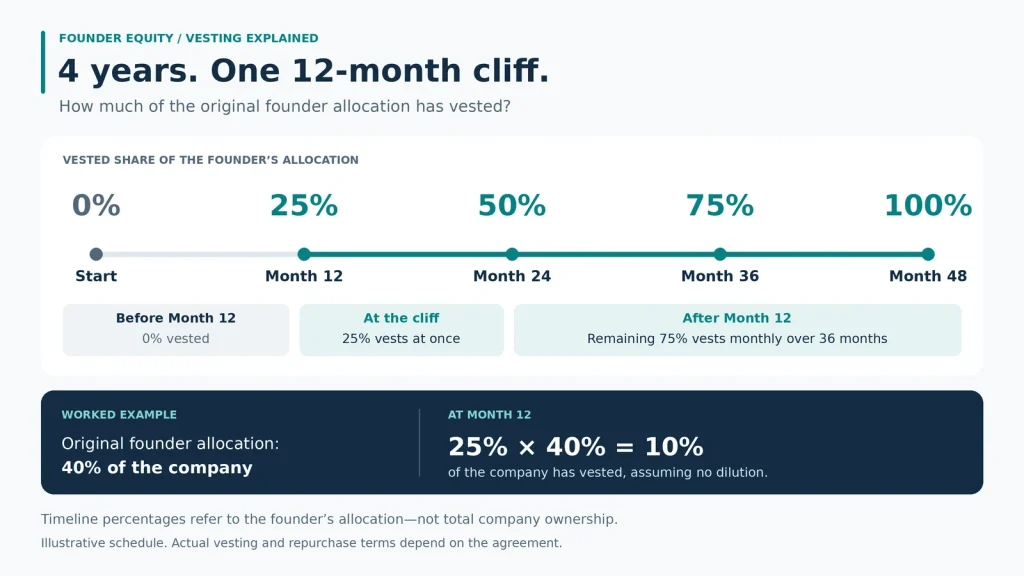
Vesting means equity is earned over time rather than handed over all at once. In practice, founder shares are often issued upfront, with the company holding a repurchase right over the unvested portion that lapses gradually as the founder stays and contributes. A cliff is the minimum period a founder must stay before any of that right lapses at all.
In US startups, a four-year vesting schedule with a one-year cliff is a common structure — with the first 12 months as the cliff and the remaining 36 months vesting monthly, not an additional four years on top of the cliff. It’s a convention, not a legal requirement everywhere, and the treatment of unvested shares depends entirely on what your actual agreement says.
Here’s the math worked through with real numbers:
A founder is allocated 40% of the company. Under a four-year vesting schedule with a one-year cliff, at the 12-month mark, 25% of that 40% allocation has vested. That’s 10 percentage points of the total company (assuming no dilution) — not 25% of the company.
That gap between “25% vested” and “25% of the company” trips people up constantly, so it’s worth writing down explicitly in your agreement.
One more distinction worth knowing: vesting on founder shares is usually structured as reverse vesting or a repurchase right, which works a little differently from how employee stock options vest. Don’t assume the two work identically.
This is not a step to improvise — confirm your specific vesting and departure terms with a lawyer before you rely on them.
Step 6 — Model Dilution Before Agreeing
Percentages on day one won’t look the same after your first funding round, and founders are sometimes surprised by how much. Here’s a simplified, illustrative example:
| Stage | Founder A | Founder B | Employee Pool | New Investor |
|---|---|---|---|---|
| Initial split | 60% | 40% | 0% | 0% |
| After creating a 10% option pool | 54% | 36% | 10% | 0% |
| After investor takes 20% post-money | 43.2% | 28.8% | 8% | 20% |
Assumptions: fully diluted illustration; the investor dilutes all existing holders proportionately; no pool top-up, SAFE/note conversion, or other adjustments included.
Notice that the ratio between Founder A and Founder B (60:40) stays exactly the same throughout — what shrinks is everyone’s share of the total company as the pie grows. That distinction matters when you’re negotiating your original split: you’re really deciding a ratio, not a fixed number.
How much you dilute in that round depends on more than just the raise amount — valuation and financing terms shape it too. If you’re still figuring out how much outside capital you’ll need to raise, see our guide on how much funding your startup needs.
Step 7 — Document the Agreement and Decision Rules
A percentage without paperwork isn’t protection. Your written agreement should cover:
- Shares and the basis for ownership.
- Roles and commitments each founder has agreed to.
- Vesting and departure treatment.
- IP assignment to the company.
- Board and shareholder decision rights.
- Transfer restrictions and how disputes get resolved.
- What approval is required to change any of this later.
An informal spreadsheet or a group chat agreement is not a legally complete substitute for this.
Have jurisdiction-specific documents drafted by a qualified startup lawyer rather than relying on a template.
Cofounder Equity Split Examples for Different Teams
All of the examples below are hypothetical illustrations built to show how the reasoning plays out — not real startup case studies with verified numbers.
Example 1 — Two Equally Committed Founders
Both founders join full-time on the same day, take on comparably weighted responsibilities, and carry similar financial risk. An illustrative 50/50 split fits this picture reasonably well — though vesting and governance terms still need to be spelled out in writing regardless of how even the split is.
Example 2 — One Full-Time and One Part-Time Founder
Say Founder A quits their job on day one and works full-time from the start, while Founder B keeps a day job and contributes evenings and weekends, with a defined milestone — say, the product reaching its first paying customers — as the trigger for Founder B to go full-time.
The agreement also spells out what happens if that milestone isn’t reached within an agreed window (for example, a set date by which Founder B must go full-time regardless, or the ratio being revisited instead).
An illustrative, negotiated split here might be 60/40 in favor of Founder A — reflecting the immediate full-time risk and workload — with a written condition that the ratio gets reviewed once Founder B converts to full-time and both are carrying comparable risk. A review doesn’t mean the ownership percentage changes automatically; any change still needs to be agreed and documented at that point.
The limitation: this 60/40 figure is illustrative, not a formula output. There’s no rule that says “the full-time founder always deserves 60%” — a different pair of founders with a shorter transition period, or a part-time founder bringing significant existing IP, might reasonably land somewhere else entirely. Whatever ratio you agree on, and whatever happens when the part-time founder eventually goes full-time, needs to be written into a formal agreement rather than assumed. Here, the percentages describe the two founders’ shares of the total company at inception, before any option pool or outside investment.
Example 3 — An Equity Split Between Three Founders
Take three founders: Founder A is CEO and Founder B is a full-time technical cofounder, both joining at the same time with comparable risk; Founder C joins two months later as a part-time growth lead while finishing an existing contract.
An illustrative negotiated split might be 40/35/25 — A and B close to each other given equal time and risk, with A holding a modest premium tied to specific agreed responsibilities (final call on product and fundraising decisions, for instance) rather than the CEO title alone, and C weighted lower to reflect the later, part-time start. These percentages describe the founders-only pool, not the total company.
This isn’t a standard or recommended default for three-person teams — it’s one possible outcome for this specific scenario, and a different set of roles or timelines could just as easily justify something close to an equal three-way split instead. Be explicit, in your own agreement, about whether numbers like these describe the founders-only pool or the total company, since those two things are easy to mix up.
Example 4 — A Technical Cofounder Joins Later
Suppose a non-technical founder has already built a working prototype and signed a handful of early customers over four months, then brings on a technical cofounder to take over engineering and product going forward. In this specific scenario, the two founders might negotiate a 30% founder-pool share for the later-joining technical cofounder, reflecting a meaningful and ongoing role, weighed against the existing product and traction already built before they joined. This 30% is a hypothetical agreed number for this scenario, not a market benchmark — a different company, product stage, or negotiated role could reasonably land anywhere else.
Joining later, on its own, doesn’t automatically mean employee-level equity instead of founder-level equity — and there’s no universal “technical founder premium” either. The real question this example is meant to illustrate is whether the new person is joining as a founder carrying long-term ownership stakes and risk, or as a senior early employee — and that distinction should drive the number, not their job title or when they showed up.
A Simple Cofounder Equity Split Worksheet
This worksheet is a practical starting point for your conversation — not an automated calculator with a definitive output.
| Factor | Agreed Weight | Founder A Score | Founder B Score | Evidence / Assumptions |
|---|---|---|---|---|
| Future time commitment | ||||
| Ongoing responsibility | ||||
| Relevant execution capability | ||||
| Existing transferable assets | ||||
| Financial risk or contribution |
How to use it:
- Agree on weights together that total 100%.
- Use one consistent scoring scale across every factor.
- Write down the reasoning behind every score — not just the number.
- Watch for overlap between factors so you don’t count the same contribution twice.
- Treat the output as a negotiation starting point, not a final answer.
Optional illustrative formula:
Founder weighted score = sum of (factor weight × founder score) Indicative founder-pool share = founder weighted score ÷ combined founder scores × 100
Here’s a hypothetical filled-in version, using a 1–5 scoring scale (1 = low, 5 = high) and weights the two founders agreed on together — the numbers below are illustrative only, not a template to copy:
| Factor | Weight | Founder A Score (1–5) | Founder B Score (1–5) | Founder A Weighted | Founder B Weighted |
|---|---|---|---|---|---|
| Future time commitment | 35% | 5 | 4 | 1.75 | 1.40 |
| Ongoing responsibility | 25% | 4 | 4 | 1.00 | 1.00 |
| Relevant execution capability | 20% | 4 | 3 | 0.80 | 0.60 |
| Existing transferable assets | 10% | 3 | 2 | 0.30 | 0.20 |
| Financial risk or contribution | 10% | 4 | 3 | 0.40 | 0.30 |
| Total (weights sum to 100%) | 4.25 | 3.50 |
Indicative founder-pool share = each founder’s weighted total ÷ the combined total, times 100. Here that’s 4.25 ÷ 7.75 ≈ 54.8% for Founder A, and 3.50 ÷ 7.75 ≈ 45.2% for Founder B — of the founder pool, not necessarily of the total company after any option pool or outside investment.
A fair warning: change the weights, and the result changes with it. This worksheet is not an objective valuation, legal advice, or a guarantee of fairness — it’s a structured way to make sure both of you are talking about the same variables.
Common Cofounder Equity Split Mistakes
- Splitting equity purely because of who had the idea. Ideas are cheap; execution is what actually builds the company.
- Defaulting to 50/50 just to skip an uncomfortable conversation. Skipping the conversation doesn’t make future resentment go away.
- Assuming 51/49 automatically resolves disagreements. Governance documents, not two extra percentage points, determine who actually controls what.
- Ignoring vesting and departure terms. Without them, an early cofounder exit can leave a large, unearned chunk of equity sitting with someone no longer contributing to the company.
- Confusing founder-pool percentages with total-company ownership. Always be explicit about which base your number refers to.
- Treating a worksheet score as the final word. It’s a discussion tool, not a verdict.
- Making verbal promises instead of documenting them. An undocumented promise is much harder to prove or enforce later — what actually happens if it’s disputed depends on your jurisdiction and circumstances, which is exactly why it needs to be in writing.
Frequently Asked Questions
How much equity should a cofounder get?
There’s no universal percentage. It depends on role, stage, time commitment, and the risk each founder is genuinely taking on — which is why the seven-step process above matters more than any rule of thumb.
Should cofounders choose 50/50 or 51/49?
Both address ownership, not governance. A single extra percentage point doesn’t guarantee decision-making control — that comes down to board structure, voting thresholds, and reserved matters written into your shareholder agreement.
How do you split equity between three founders?
Either an equal three-way split or a reasoned unequal one can work, depending on differences in commitment and contribution. Whichever you choose, be explicit about whether the percentages describe the founders-only pool or the entire company.
How much equity should a late-joining cofounder receive?
It depends on the company’s stage at the time they join and what they’re realistically contributing going forward — there’s no fixed industry range to plug in.
What happens to equity when a cofounder leaves?
That depends entirely on your vesting schedule, any repurchase or reverse-vesting rights in the founder agreement, and what’s actually been signed. Without those documents in place, the outcome is far messier than it needs to be.
Can founders change their equity split later?
Yes, but not informally or unilaterally. Changing it typically requires proper approvals, updated documentation, and sometimes has tax or legal consequences worth reviewing with a professional first.
Is 1% equity enough for a cofounder?
It depends heavily on context. A true early-stage cofounder joining at inception is a very different situation from an advisor or a later employee receiving a 1% grant — company stage, valuation, and actual responsibilities all factor in before that number means anything.
Before You Finalize the Split
Three things matter more than the exact percentage you land on: agreeing openly on future contribution rather than past history, giving vesting and governance the same weight as the raw numbers, and running a dilution model plus a legal review before anyone signs.

Before your next conversation, have each founder fill out the worksheet above independently — then sit down together and compare where your assumptions actually differ. That gap is usually where the real conversation needs to happen.
This article is for educational purposes and does not constitute legal or tax advice. Speak with a qualified startup lawyer before finalizing any equity or vesting agreement.