How to Find a Technical Cofounder (Even Without a Network)

You have a startup idea, you’ve spoken to potential customers, and you understand the problem you want to solve. Now you need someone who can help turn it into a working product. If you’re wondering how to find a technical cofounder, the goal is to find a technical partner who can build the product and share responsibility for the business.
It’s even tougher when you don’t have a startup network. No developer friends, no ex-colleagues who’ve built products, no warm introductions. Just you and a strong belief that the problem is worth solving.
Here’s the shift that helps: you’re not hiring a developer. You’re looking for a long-term partner who shares responsibility for the product, the direction, and the risk. That’s a different search, and it needs a different approach.
This guide walks through it step by step: what to define first, where to look, how to reach out, how to test the fit, and what to do if the right person doesn’t show up quickly.
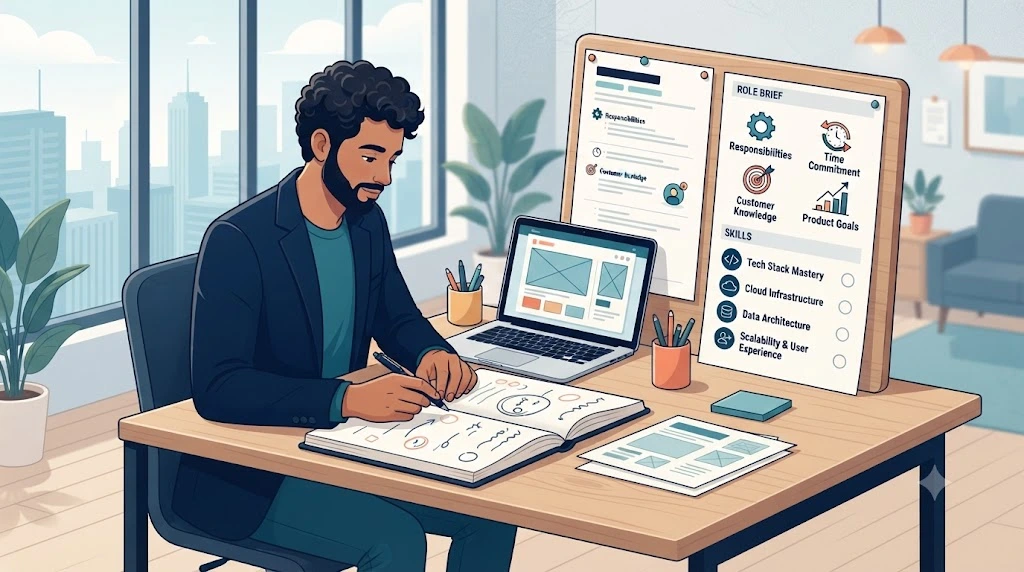
1. Define What You Need in a Technical Cofounder
Before you message anyone, get clear on what the role actually is. Vague searches attract vague conversations.
Identify the technical skills your startup requires
A mobile app, a data-heavy SaaS tool, and a marketplace all need different builders. Write down what the first version of your product has to do, then list the skills that make it possible: backend, mobile, AI, integrations, security.
You don’t need to speak the language perfectly. You just need a clear picture of the problem you want solved.
Define what you will contribute as a founder
A potential technical cofounder will want to understand what you bring to the business. That could be customer insight, sales experience, industry expertise, early customer relationships, distribution, or a clear understanding of the problem. Be specific about your strengths and the responsibilities you’re prepared to own; don’t imply traction or experience you don’t have.
Decide on commitment, availability, and startup stage
Are you full-time or still employed? Do you have savings for six months or twenty-four? Is this a prototype stage or are paying customers waiting?
A candidate who joins a pre-idea experiment and one who joins a funded product have very different expectations. Be honest about where you are.
2. Where to Find a Technical Cofounder
No single channel works for everyone. Each one trades speed for trust, or reach for relevance. Here’s how they compare.
Use cofounder matching platforms
Start by exploring Y Combinator’s Co-Founder Matching platform, which lets prospective founders discover and connect with potential cofounders.
Benefit: you meet people who already want a cofounder, so you skip the awkward “are you even interested?” stage. YC’s platform is free and takes no equity.
Limitation: profiles can look better than people feel. A strong bio tells you little about how someone handles disagreement at 11 pm. Treat a match as a first conversation, not a verdict.
Join developer and startup communities
Slack groups, Discord servers, local meetups, and online forums are where builders talk shop.
Benefit: you can watch how people think and help before you ever ask for anything.
Limitation: it’s slow. Show up for a few weeks, answer questions, share what you’re learning. Walking in on day one with a pitch tends to backfire.
Attend hackathons and startup events
Weekend hackathons put people under time pressure, which shows you how they work faster than any interview.
Benefit: you see real collaboration. Who ships, who communicates, who stays calm when the demo breaks.
Limitation: the people there are often committed to their own ideas, and a single weekend can’t tell you about long-term compatibility.
Connect through open-source projects and professional networks
You can explore open-source projects on GitHub to discover developers working in a technical area relevant to your startup.
Benefit: public code shows how someone works: how they write, document, and respond to feedback. It doesn’t tell you whether they want a startup role, so treat it as a place to start a conversation, not proof of availability.
Limitation: many open-source contributors do it for love, not startups. A thoughtful, specific message about their work goes much further than a mass request. LinkedIn and alumni groups work the same way: relevant, personal, and short.
3. How to Find a Technical Cofounder Without a Network
No network doesn’t mean no chance. It means you build one on purpose, in small steps.
Build a shortlist of relevant candidates
Pick 15 to 20 people, not 200. Look for builders with experience in your problem area or your technology, and some sign they enjoy early-stage work: side projects, past startups, open-source contributions.
A short list lets you personalize every message.
Write personalized outreach messages
Generic messages get ignored. A good one says who you are, why this person, and what you’re asking for. And the ask should be small: a 20-minute chat, not “will you be my cofounder?”
Here’s a short example:
Subject: Your work on [project]
Hi [Name],
I came across your work on [specific project] and was particularly interested in [specific detail]. I’m exploring a problem affecting [target customer] and have been speaking with potential customers to understand their needs.
I’m looking for a technical cofounder who would be interested in building a business together, rather than someone to complete a one-off project. Would you be open to a 20-minute conversation to discuss the problem and see whether our interests align?
Thanks,
[Your name]
Show evidence of customer research or product progress
Evidence can help you build credibility even when you don’t have an established network. Customer interview notes, a landing page with sign-ups, a pilot customer, or a clickable prototype can show a potential partner that you’ve taken the problem seriously. Use only evidence you actually have, and be clear about what it does—and doesn’t—prove.
Before approaching potential partners, validate your startup idea before building an MVP so you can explain the customer problem and the evidence behind your idea.
Follow up without pressuring candidates
People are busy. If there’s no reply, wait about a week, then send one short follow-up that adds something new, like a customer quote or a small update. If there’s still no answer, move on politely.
Pressure ends conversations. Patience keeps doors open.
Real example: How Canva found its technical cofounder
Canva’s founding story shows why relationships and persistence can matter when searching for a technical partner. Melanie Perkins and Cliff Obrecht were developing their vision for an online design platform when investor Bill Tai helped connect them with Lars Rasmussen, co-founder of Google Maps.
Rasmussen introduced Adams to Perkins and Obrecht. Adams initially declined, but after reconsidering the opportunity, he reconnected with the founders and agreed to join them. The experience illustrates how introductions can open doors, while shared vision and mutual interest help turn a connection into a partnership.
The lesson is not that every founder needs an investor introduction. It’s that demonstrating a clear vision, building relevant relationships, and continuing conversations can help you meet people whose skills and goals complement your own.
Source: First Round Review’s interview with Cameron Adams.

4. How to Approach a Potential Technical Cofounder
Once someone agrees to talk, the first real conversation matters. Keep it honest and two-sided.
Explain the problem and target customer
Start with the customer, not the product. Who has the problem? How do they handle it today? Why does it hurt?
Two or three minutes is enough. If you can’t explain it simply, a builder will notice.
Share what you have validated so far
Be specific: how many people you talked to, what they said, what they’d pay, what you still don’t know.
Don’t hide the gaps. Builders trust founders who say “I’m not sure yet” more than those who oversell.
Discuss why you want to build this business
Why this problem? Why now? Why you?
Personal motivation shows. A founder who’s lived the problem, or can’t stop thinking about it, is easier to believe than one chasing a trend.
Ask about the candidate’s interests and goals
Then stop talking. Ask what they want to build, what they’ve learned from past projects, and what kind of company they’d enjoy working in.
If their goals sit far from yours, better to find out now.
5. How to Evaluate a Technical Cofounder
A good call isn’t a good cofounder. And a coding test, on its own, only measures coding.
Review previous projects and shipped products
Look at what they’ve actually launched. Ask what they owned, what went wrong, and what they’d do differently. Real experience usually comes with honest stories about mistakes.
Work together on a small trial project
Before committing to a partnership, agree on a small, time-limited trial project. You might test a product assumption, create a simple prototype, or prepare a customer demonstration. Define the scope, each person’s contribution, ownership of the work, and any payment or expense arrangements in advance. The goal is to learn how you work together—not to obtain unpaid production work.
You’ll learn how decisions get made, how feedback lands, and whether you enjoy the work together.
Evaluate communication and problem-solving
Watch how they respond when plans change or something breaks. Do they explain clearly? Do they ask questions? Do you feel heard?
Discuss long-term commitment and expectations
Before committing to a partnership, use these questions to discuss with a potential cofounder to surface differences in goals, roles, and expectations.
One conversation or one coding test can’t establish cofounder compatibility. YC notes that questionnaires don’t replace time spent working together, and that it often takes several months to know for sure. Give the relationship that time.
6. Discuss Roles, Responsibilities, and Equity
Keep this part clear and written down.
Agree on ownership of major responsibilities
Decide who owns product, engineering, sales, hiring, and fundraising. Roles will change, but the first 6 to 12 months should have a plan.
Discuss time commitment and full-time plans
Is each of you full-time now? If not, what has to happen first: funding, a paying customer, a set date? Write it down.
Address equity and vesting before making commitments
Before agreeing on ownership, review the guidance on a cofounder equity split and discuss future contributions, commitment, and vesting.
Don’t promise a number in your first call. Agree on expectations first, then put the terms in writing with a startup lawyer.
7. Common Mistakes to Avoid When Finding a Technical Cofounder
- Choosing on technical skills alone. Technical ability matters, but a cofounder also needs compatible goals, sound judgment, reliable communication, and a willingness to share responsibility for the business.
- Sending generic outreach messages. If your message could go to anyone, it will be treated that way.
- Promising equity before discussing expectations. An early promise can lock you into a deal that doesn’t match what each person actually does.
- Skipping trial collaboration. A coffee chat can’t show how you’ll make decisions, handle feedback, or work through setbacks together. Try a small, clearly scoped project before making a long-term commitment.
- Ignoring disagreements about commitment or company direction. Small differences now become big conflicts later.
8. What If You Cannot Find a Technical Cofounder?
It happens, and it isn’t failure. Some searches just take longer.
Continue customer discovery and validate the problem
Keep talking to customers. Every conversation makes your story stronger and your future pitch easier.
Consider a contractor for clearly defined technical work
If you need a prototype or a specific feature, a contractor can build it while you keep searching. Just keep the scope tight, and be clear that it’s a contract, not a partnership.
Reassess the product’s technical requirements
Ask whether version one really needs custom code. A no-code tool, a manual service, or a simpler feature set might let you test demand sooner and attract a builder with real traction.
Continue searching without rushing into a partnership
A poorly matched cofounder can create more problems than waiting for the right partner. Keep showing up, share progress, and continue the search without rushing into a commitment.
Frequently Asked Questions
Where can I find a technical cofounder?
Cofounder matching platforms, developer communities, hackathons, and open-source projects are the main starting points. Pick two or three and show up consistently instead of spreading yourself thin.
How do I find a technical cofounder if I cannot code?
Bring customer evidence and a clear role for yourself, then ask for a conversation before asking for a commitment. Coding ability isn’t the requirement; clarity about the problem is.
How do I approach a technical cofounder?
Start with a short, personal message about their work and a small request, such as a 20-minute call. Leave equity and titles for later conversations.
Should I give a technical cofounder equity?
A genuine cofounder typically receives equity because they share responsibility for building the company and taking on its risks. The amount depends on each founder’s role, expected contribution, commitment, and the agreement between them. Discuss vesting and document the terms before finalizing the arrangement. For fixed-scope contract work, fees are generally clearer than treating the contractor as a cofounder.
How do I know if a technical cofounder is a good fit?
Shared goals, honest communication, and a good experience on a small trial project are the strongest signals. Give it time instead of deciding after one meeting.
Conclusion
Finding a technical cofounder isn’t about luck. It’s a process you can follow.
Define the role. Search where builders spend their time. Reach out personally, with proof that you’ve done your homework. Work on something small together before committing. And agree on roles, time, and equity early, in writing.
Above all, look for shared goals and real working compatibility, not just a good resume. The right person is worth the wait.
Ready to start? This week, write your one-page role brief and send three personalized messages. Then keep going.