
How to Test Willingness to Pay Before Building a Product

Here’s an uncomfortable truth most founders learn the hard way: people love giving compliments, but they’re far more cautious with their wallets.
You show someone your idea, and they say “I’d definitely use this.” You post a survey, and 80% tick “very interested.” Your sign-up form fills up overnight. Everything feels like validation.
Then you launch. And nobody buys.
The problem isn’t your product. It’s that you validated interest, not intent. Free sign-ups, warm compliments, and survey enthusiasm are cheap to give and even cheaper to forget. Real validation only shows up the moment someone reaches for their card — because money is the one signal people can’t fake without actually feeling it.
This guide walks through seven practical, field-tested methods to test willingness to pay before you write a single line of production code, plus how to read the results honestly.
What Does Willingness to Pay Actually Mean?
Willingness to pay (WTP) is the maximum amount a customer will hand over for a product or service, based on the value they believe it delivers. It sounds simple, but founders confuse it with two very different things.
Interest is not intent. Someone can be genuinely curious about your product and still never buy it. Interest costs nothing; payment costs something.
Maximum WTP is not a fixed price. It’s the ceiling, not the sticker price. Your job isn’t to find one magic number — it’s to find an acceptable range where enough customers say yes often enough to build a business.
This distinction matters most before you build anything. Once you’ve sunk months into an MVP, it’s tempting to rationalize weak signals as strong ones. Testing WTP early keeps you honest before that bias sets in.
If you haven’t nailed down the problem itself yet, it’s worth reading how to validate your startup idea before building an MVP first — willingness to pay only means something once you know you’re solving a real problem.
Why Customer Interviews Alone Can’t Prove Willingness to Pay
Interviews are a great starting point. They’re also, on their own, a terrible finish line.
Here’s why: when you ask someone directly, “Would you pay for this?” — you’re asking them to predict their own future behavior under imaginary conditions. Humans are famously bad at that.
Worse, most people are polite by default. Sitting across from a founder who’s clearly passionate about their idea, saying “no, I wouldn’t pay for that” feels almost rude. So they say yes. They mean it in the moment. They just don’t act on it later.
This is the core weakness of the classic mistake: “Would you buy this?” is a hypothetical question that produces hypothetical answers. What you actually need is behavior — a click, a deposit, a pre-order — because behavior carries real financial and emotional cost, and cost is what separates a genuine signal from a polite one.
How to Test Willingness to Pay: 7 Proven Methods

1. Ask Customers About Their Existing Spending
Before you ask about your product, ask about their current reality. What are they using right now to solve this problem? How much are they already spending on it?
Past behavior is a far better predictor of future payment than hypothetical intent, because it’s already proven — they’ve done it before, under real conditions, with real money.
Strong questions to ask:
- When was the last time you tried to solve this problem?
- What solution did you end up buying or using?
- How much did you spend on it?
- What’s the biggest gap in your current solution?
If someone is already spending money and still frustrated, you’ve found a real opportunity. If nobody’s spending anything, that’s a signal worth taking seriously.
2. Use the Van Westendorp Price Sensitivity Meter
This is a classic four-question pricing survey that maps out a range rather than a single number.
Ask respondents:
- At what price would this product be so cheap you’d question its quality?
- At what price would it feel like a great deal?
- At what price would it feel expensive, but you’d still consider it?
- At what price would it be too expensive to consider at all?
Plotting the answers across your sample gives you an acceptable price range — not a guarantee of demand, but a realistic corridor to price within. It’s a research tool, not a sales tool, so treat the output as a starting hypothesis, not a final answer. (For a deeper walkthrough of the methodology, see SurveyMonkey’s guide to the Van Westendorp Price Sensitivity Meter.)
3. Run a Gabor-Granger Pricing Test
Where Van Westendorp maps a range, Gabor-Granger tests specific prices directly.
You show different respondents (or the same respondent, sequentially) a set of specific prices and ask how likely they are to buy at each one. Plotting purchase likelihood against price reveals your demand curve.
A simple example: If you show ₹499 and 70% say they’d buy, then ₹799 and only 40% say yes, and ₹1,199 drops to 15%, you now have a rough revenue-maximizing price point — not just a “fair” one.
4. Create a Fake-Door Landing Page

This is one of the most direct ways to test real intent before building anything.
Build a landing page with a clear value proposition, the core features, your target customer described plainly, and real pricing tiers. Add a “Buy Now” or “Get Early Access” call-to-action.
If the product is not available for purchase, do not collect payment details. Measure CTA clicks, pricing-plan selections, or early-access requests instead, and clearly disclose that the product is still being developed.
Then track your conversion rate from visitor to click to pricing-plan selection. Keep in mind that these clicks show behavioural intent, not financial commitment — they tell you people are curious enough to act, not that they’ve actually paid.
A word of caution: never mislead people about launch status or hide refund terms. The goal is honest validation, not a trick. Transparency protects both your reputation and your data quality.
5. Ask for a Refundable Deposit
An email sign-up costs nothing. A refundable deposit costs something — even if it’s fully returnable, the act of entering payment details and clicking “confirm” filters out casual interest.
Set a small, clearly refundable amount. State the payment and refund terms upfront, in plain language, before anyone pays. Then measure your deposit conversion rate against total visitors or leads.
This single number — deposits divided by qualified prospects — tends to be one of the most honest signals you’ll get pre-launch.
6. Sell Pre-Orders Before Full Development
If you can show a mockup or working prototype, pre-orders take validation a step further than deposits — you’re asking people to commit real money to something they’ll receive later.
Be explicit about your delivery timeline and refund policy. This works for physical products (a hardware startup pre-selling units before manufacturing) and digital products alike (a SaaS tool pre-selling annual plans before the dashboard is finished).
Real pre-order revenue is one of the strongest forms of demand validation available, because it combines financial commitment with patience — people are willing to wait and pay.
7. Offer a Paid Pilot or Concierge MVP
For B2B, SaaS, or service-based startups, this is often the gold standard.
Instead of building software, deliver the outcome manually — spreadsheets, calls, hands-on service — to a small number of paying customers. Charge them for it. Watch how they actually use what you deliver and what results they get.
This validates repeatable demand before you invest in automation, and it often surfaces the exact features worth building first, because you’re watching real usage instead of guessing at a roadmap.
Which Willingness-to-Pay Test Should You Choose?
| Product Situation | Best Test | Strength of Signal |
|---|---|---|
| Idea is still early-stage | Existing spending interviews | Medium |
| Need to understand price range | Van Westendorp | Medium |
| Comparing specific price points | Gabor-Granger | Medium |
| You have audience or traffic | Fake-door landing page | Strong |
| Need financial proof of demand | Refundable deposit | Very strong |
| Can clearly demonstrate the product | Pre-order | Very strong |
| B2B or service-based solution | Paid pilot | Strongest |
Real Case Study: How Buffer Validated Willingness to Pay Before Writing Code

One of the most cited examples of pre-build validation comes from Buffer, the social media scheduling tool, and it’s still one of the clearest illustrations of testing willingness to pay before building anything.
Buffer’s founder, Joel Gascoigne, wanted to solve his own frustration with scheduling tweets. But having watched a previous startup fail, he refused to code first and validate later. Instead, he built a two-page landing site: the first page explained the idea, and the second simply collected email addresses from people who wanted early access.
Once he saw people were genuinely interested, he went a step further. He inserted a third page — a pricing page — between the pitch and the email signup. Clicking through to see plans required one extra step, and clicking a specific paid plan required real intent. That extra click helped him identify stronger purchase intent and compare interest across pricing plans. However, because customers were not charged, it remained a stronger behavioural signal — not definitive proof of willingness to pay.
The results were telling: people kept clicking through and leaving their email, and a small but meaningful share were clicking on the paid plans. That signal gave Gascoigne enough confidence to move forward — he didn’t hesitate to start building the first minimal version of the actual product.
The lesson holds for any founder today: a pricing page with a real call-to-action tells you more, faster, than months of development ever could — but a click on a price plan is still a step below a completed payment, and it’s worth treating it that way when you weigh your own results. (You can read Gascoigne’s original account of the test on Buffer’s own site.)
How Much Evidence Is Enough to Validate Willingness to Pay?
One sale is a story, not a pattern. Before you commit to building, look for repeatability within your actual target segment — not just enthusiasm from friendly early adopters.
These figures are practical starting targets, not statistically guaranteed validation thresholds.
A reasonable starting benchmark:
- 15–25 problem interviews
- 100+ relevant landing-page visitors
- 5–10 deposits, pre-orders, or paid pilot commitments
- More than one price point tested
These aren’t universal laws — a high-ticket B2B tool will validate on far fewer commitments than a low-cost consumer app. Judge your results against your product’s value and your traffic quality, not against a generic checklist.
How to Calculate Your Willingness-to-Pay Conversion Rate
Here’s the formula that matters more than any survey score:
WTP Conversion Rate = Paying Commitments ÷ Qualified Prospects × 100
Example:
- 100 qualified visitors
- 12 checkout clicks
- 5 refundable deposits
- Real commitment rate = 5%
Notice what’s missing from that formula: email sign-ups and page clicks. Treat paid commitments — not vanity metrics — as your primary indicator of real demand.
Common Mistakes When Testing Willingness to Pay
- Asking “Would you buy this?” instead of observing behavior
- Validating with friends and family instead of real target customers
- Building only a free waitlist and calling it demand
- Discounting the price too early to force a “yes”
- Testing the wrong audience entirely
- Testing only a single price point
- Mistaking compliments for commitment
- Hiding refund and delivery terms
- Continuing to build even after clearly negative results
What to Do If Customers Are Not Willing to Pay
A weak result isn’t a dead end — it’s data. Before abandoning the idea, work through these steps:
- Re-examine the urgency of the problem — is it a real pain point or a mild annoyance?
- Revisit your customer segment — are you testing the right buyer?
- Sharpen your value proposition — is the benefit actually clear?
- Adjust your offer or product scope
- Test a different pricing or payment model
- Run a new hypothesis before deciding to abandon the idea entirely
If your validated idea is moving forward, your next question is usually funding. Here’s how to calculate how much funding your startup needs once you’ve proven real demand.
A Simple 7-Day Willingness-to-Pay Test
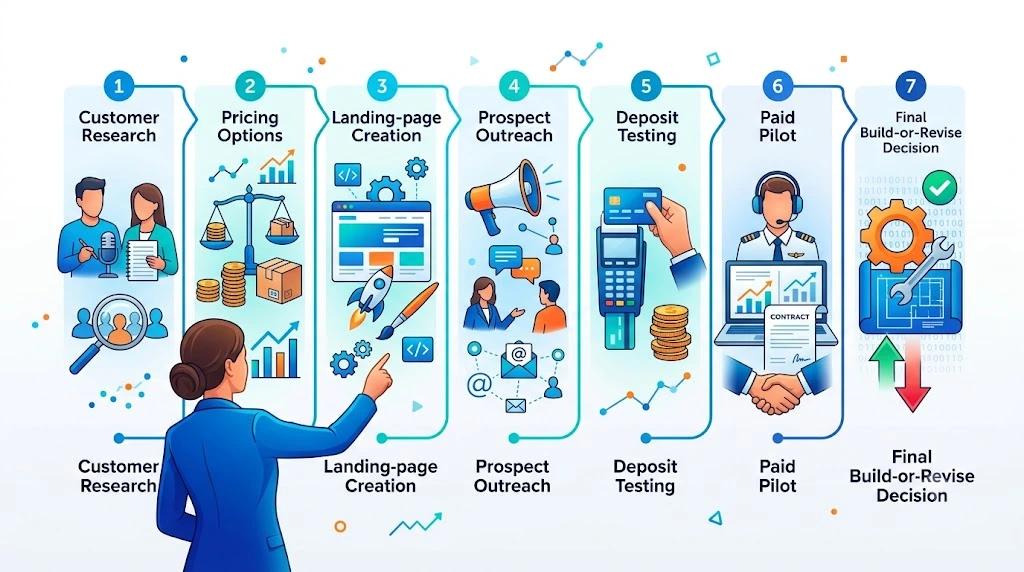
You don’t need months to get a real answer. Here’s a compressed plan:
- Day 1: Define your customer segment and the problem clearly
- Day 2: Run five customer interviews focused on existing spending
- Day 3: Build your offer and 2–3 price points
- Day 4: Put together a landing page or sales message
- Day 5: Reach qualified prospects
- Day 6: Offer a deposit, pre-order, or paid pilot
- Day 7: Compare results and decide: build, revise, or stop
Conclusion
Measure behavior, not opinions. Interviews are a good place to start, but a financial test is the only honest place to finish.
The strongest evidence you can gather — a deposit, a pre-order, a paid pilot — will always outweigh a thousand polite compliments. Before you spend months building a full product, spend a week running a small, honest, paid experiment. It’s the cheapest insurance policy your startup will ever buy.
Ready to validate your next idea the right way? Start with a single fake-door landing page this week — track real clicks, not just sign-ups — and let the numbers, not your excitement, tell you whether to build.
FAQs
How do you test willingness to pay? The most reliable way is to ask for a financial commitment — a deposit, pre-order, or paid pilot — rather than relying on surveys or interviews alone. Behavior under real financial stakes is a far stronger signal than hypothetical answers.
What is the best method for measuring willingness to pay? It depends on your stage. Early on, spending interviews and Van Westendorp surveys help map a price range. Closer to launch, fake-door pages, refundable deposits, and pre-orders give the strongest, most direct evidence.
How do you ask customers how much they would pay? Avoid asking directly. Instead, ask what they currently spend to solve the problem, and use structured tools like Van Westendorp or Gabor-Granger to surface a realistic price range through indirect questioning.
Can a free waitlist validate willingness to pay? Not on its own. A waitlist validates interest, not payment intent. Pair it with a pricing step, deposit, or pre-order to test whether that interest converts into real financial commitment.
How many customers should you test before building a product? A reasonable starting point is 15–25 problem interviews alongside 5–10 actual paid commitments (deposits, pre-orders, or pilots), adjusted for your product’s price point and target audience size.
What is the difference between willingness to pay and purchase intent? Purchase intent is a stated or implied interest in buying, often expressed through surveys or sign-ups. Willingness to pay is the actual maximum amount someone will commit financially — proven through real spending behavior, not just declared interest.