
What Is Competitive Strategy in Business? 4 Types + Examples

What is competitive strategy in business, and why does it matter for a startup with limited money, limited time, and almost zero market recognition? Because a great product isn’t enough on its own. Customers don’t just buy the best thing — they buy the thing that makes the most sense for them, at that moment, from a company they trust more than the alternative. Competitive strategy is what decides who that customer is, what they’re being offered, and why they’ll pick you over everyone else fighting for their attention.
In this guide, you’ll get a clear definition, the four classic types of competitive strategy, real examples, a simple framework to pick the right one, and the mistakes that quietly sink most early-stage businesses.
What Is Competitive Strategy in Business?
Competitive strategy is a long-term plan that positions a business clearly against its rivals by defining its target market, the value it delivers to customers, and the specific advantage that makes it hard to copy. It’s not a slogan or a mission statement — it’s the underlying logic for how a company intends to win.
Business strategy is the bigger umbrella: it covers everything from finance to hiring to expansion. Competitive strategy sits inside that umbrella and answers one narrower, sharper question — how do we beat (or avoid) the competition in the market we’ve chosen?
Key takeaway: Competitive strategy answers three questions — Who will we serve, what value will we offer, and why should customers choose us over anyone else?
Why Competitive Strategy Matters for Startups
It prevents competing with everyone
Without a defined strategy, early founders try to appeal to every possible customer. The result is a product that’s mildly interesting to a lot of people and irresistible to almost no one.
Before choosing how to compete, founders should confirm that the underlying customer problem is real. This guide to validating a startup idea before building an MVP explains how to test demand before committing resources.
It guides product and pricing decisions
Once you know whether you’re winning on cost or on differentiation, decisions get faster. Should you add that premium feature? Should you drop your price to match a competitor? Strategy answers both without a debate every time.
It helps allocate limited resources
Startups don’t have the luxury of doing everything reasonably well. A clear strategy tells you exactly where your limited hours and rupees should go — and, just as importantly, what to ignore.
It creates a consistent market position
Customers remember businesses that stand for something specific. A strategy repeated consistently across marketing, product, and pricing builds a recognizable identity much faster than a scattered approach ever could.
Competitive Strategy vs. Competitive Advantage
These two terms get used interchangeably, but they’re not the same thing.
| Competitive Strategy | Competitive Advantage |
|---|---|
| The plan chosen to win in the market | The real edge that results from the strategy |
| Future-oriented decision | A result that becomes visible in the market |
| Founder can control it directly | Also shaped by customer and competitor response |
| Example: focusing on a specific niche | Example: becoming the recognized expert in that niche |
In short: strategy is the effort. Advantage is what you get to keep if the effort actually works.
The 4 Types of Competitive Strategy in Business
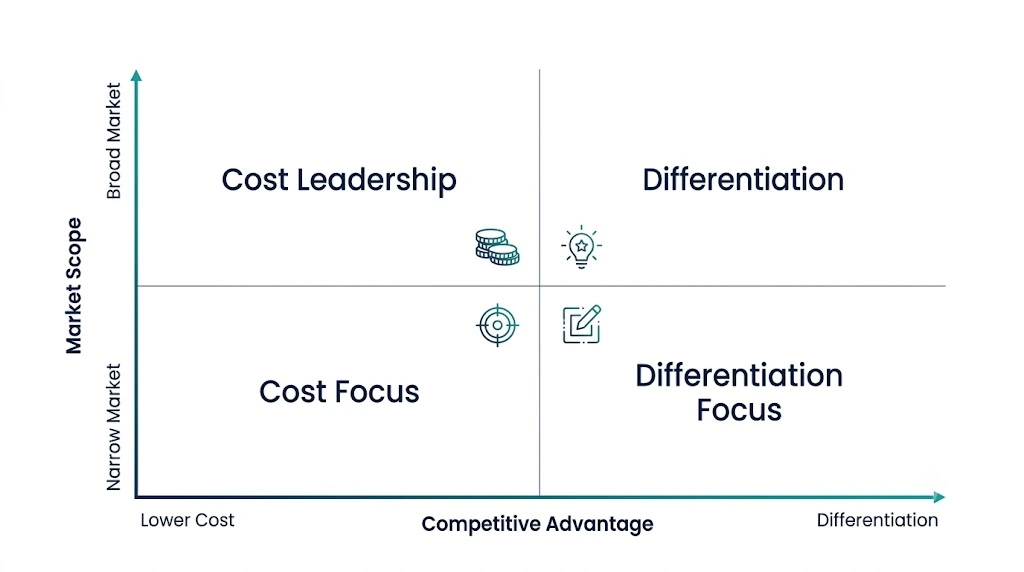
Michael Porter’s original framework, taught widely in business schools and outlined by institutions like the University of Cambridge, is built on two simple choices. Once you understand these choices, it becomes much easier to answer what is competitive strategy in business for your own startup:
- Competitive advantage — will you win on lower cost, or on meaningful differentiation?
- Market scope — will you target the broad market, or a narrow niche?
Combine those two choices, and you get four practical strategies.
1. Cost Leadership
This means becoming the lowest-cost operator across an entire broad market — not just the business with the cheapest sticker price today.
Cost leadership isn’t the same as running a permanent discount. It requires genuinely lower operating costs, built through efficient processes, scale, supply chain control, and disciplined spending. A competitor can always match a discount for a few weeks; they can’t easily replicate a decade of structural cost advantages.
Example: Walmart built its entire business around driving operating costs down through scale, logistics, and supplier negotiation, allowing it to consistently underprice most competitors.
Startup suitability: Genuinely difficult in the early days. Cost leadership usually rewards scale and capital that most startups simply don’t have yet.
2. Differentiation
Here, the goal is to create a meaningful difference that customers are willing to pay more for. That difference can come from product features, customer experience, convenience, deep expertise, or brand perception.
Example: A brand that wins primarily through a noticeably better, more consistent customer experience — even when a cheaper alternative sits right next to it on the shelf.
Startup suitability: Workable, but only if the difference is real and defendable. “We care more” is not differentiation. A demonstrably better outcome for the customer is.
3. Cost Focus
This is cost leadership applied to a narrow slice of the market instead of the entire industry. You’re not trying to be the cheapest option for everyone — just the cheapest, most efficient option for one well-defined group.
Example: A lean bookkeeping service built specifically for freelancers, stripped of the extra services a mid-sized business would need, and priced accordingly.
Main risk: A larger, better-funded competitor can eventually notice the niche and enter it with more resources.
4. Differentiation Focus
This means solving one specific problem for one specific niche better than any generalist ever could.
Example: A specialized CRM built only for dental clinics, with appointment logic, insurance workflows, and reminders built around how dental practices actually operate — instead of a generic CRM that half-fits everyone.
Startup suitability: Often the most realistic starting point for early-stage founders. You don’t need Walmart’s scale or a nationally known brand to be the obvious best choice for one narrow, underserved group.
Main risk: The niche may simply be too small to build a sustainable business on.
Porter’s original model treats focus as one strategy with two variants — cost focus and differentiation focus — which is why some analysts describe the framework as three generic strategies, and others describe it as four practical approaches.
Real Case Study: Southwest Airlines and Cost Leadership
It’s worth looking at one business that has stuck to a single competitive strategy for decades: Southwest Airlines.
Southwest has long been studied as a textbook example of Porter’s cost leadership strategy in the airline industry. Instead of trying to be everything to every traveler, Southwest deliberately built its operating model around keeping costs lower than full-service rivals.
Southwest’s operating model has historically supported a low-cost position through an all-Boeing 737 fleet, a primarily point-to-point network, frequent direct service, and efforts to improve aircraft utilization and turnaround efficiency. Using one aircraft family can simplify areas such as maintenance, training, and fleet planning, while point-to-point routing can provide more nonstop journeys than a traditional hub-and-spoke network. These are structural operating choices — not temporary discounts — which is the central lesson of cost leadership for startups.
These structural choices helped Southwest build a historically distinctive low-cost operating model, although its strategy and customer experience continue to evolve with changing market conditions.
The lesson for a startup isn’t “cut everything.” It’s that cost leadership only works when the savings come from how the business actually operates — not from a temporary price cut competitors can match in a week.
Competitive Strategy Examples for Startups
| Startup Type | Target Market | Strategy | Competitive Edge |
|---|---|---|---|
| Budget bookkeeping platform | Freelancers | Cost focus | Simple, low-cost service |
| Industry-specific SaaS | Dental clinics | Differentiation focus | Specialized workflows |
| Premium D2C brand | Quality-conscious buyers | Differentiation | Product quality and experience |
| Low-cost delivery platform | Broad local market | Cost leadership | Operational efficiency |
Note: Examples marked as generic startup types above are illustrative. Real company names are used only where their strategy is backed by verifiable, publicly reported sources — as with the Southwest Airlines case study.
How to Choose the Right Competitive Strategy
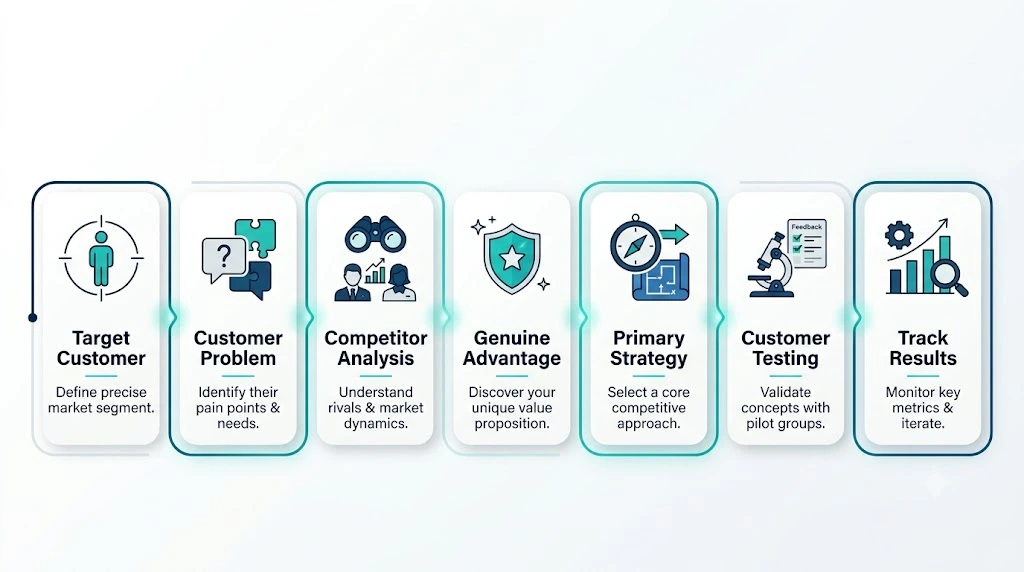
Step 1: Define a narrow target customer
Not “small businesses.” Something closer to “solo consultants who bill hourly and hate manual invoicing.”
Step 2: Identify the customer’s most important problem
The problem they’d pay to make disappear today — not a problem they’d merely find interesting to solve someday.
Early customer conversations can reveal whether that problem is urgent enough to influence a purchase. These strategies for finding your first 100 customers can also help founders test their positioning with real buyers.
Step 3: Analyze direct and indirect competitors
Look at who else is already solving this problem, including the imperfect workarounds — spreadsheets, agencies, doing it manually — that customers currently tolerate.
Step 4: Map your genuine cost or differentiation advantage
Be honest here. An advantage that only exists in a pitch deck won’t survive contact with real customers.
Step 5: Choose one primary strategy
Trying to be the cheapest and the most premium option at once usually satisfies neither positioning.
Step 6: Test it with real customers
Put the strategy in front of actual buyers before scaling spend around it.
Step 7: Track whether the advantage is strengthening
A good strategy should get harder to copy over time, not easier.
Quick decision checklist:
- Can we genuinely deliver at a lower cost than rivals?
- Do customers actually value the difference we’re offering?
- Is the niche large enough to sustain the business?
- Can competitors copy our approach easily?
- Does this strategy fit the resources we actually have?
Common Competitive Strategy Mistakes
Trying to serve every customer
The fastest way to end up with a product nobody feels strongly about.
Confusing low price with cost leadership
A discount is not a strategy. It’s a temporary tactic that disappears the moment a competitor matches it.
Claiming differences customers don’t value
Founders often love features that customers barely notice. Differentiation only counts if the market agrees it’s meaningful.
Copying a large competitor’s strategy
What works at scale for a funded incumbent often collapses under a startup’s cost structure.
Choosing a strategy without operational support
A “premium” positioning falls apart fast if support, packaging, or delivery don’t match the promise.
Once the positioning is clear, founders can use these AI workflows for automating startup operations to make execution more consistent without immediately expanding the team.
Remaining “stuck in the middle”
Businesses caught between cost leadership and differentiation — not clearly the cheapest, not clearly the best — tend to lose to both sides. That said, some modern research on “best-cost” or hybrid positioning argues a carefully balanced middle ground can work in specific markets, though it remains far riskier for early-stage companies than picking one clear lane.
A Simple Competitive Strategy Template
Fill in the blanks below to force clarity on your own positioning:
We serve [specific customer] who struggles with [important problem]. Unlike [main alternatives], we provide [distinct value] through [capability or business system]. We will measure success using [metric].
Filled example:
We serve solo dental practices who struggle with juggling appointments, insurance claims, and reminders across three disconnected tools. Unlike generic CRMs, we provide one unified, dental-specific workflow through purpose-built scheduling and insurance automation. We will measure success using monthly active clinics and appointment no-show reduction.
How to Measure Whether the Strategy Is Working
- Customer acquisition cost
- Conversion rate
- Customer retention
- Gross margin
- Price premium customers are willing to pay
- Win/loss reasons from lost deals
- Market-share movement within the chosen niche
The right metrics depend on the strategy itself. A cost-focused business should watch efficiency and margin closely; a differentiation-focused business should watch willingness to pay and retention, since that’s where the real proof of “meaningful difference” shows up.
Final Takeaway
To sum up what is competitive strategy in business: it’s the long-term plan that defines who you serve, what value you deliver, and why customers pick you over the alternatives — and choosing one deliberately is often the difference between a startup that drifts and one that grows on purpose. The four practical paths — cost leadership, differentiation, cost focus, and differentiation focus — all come from the same two choices: cost or differentiation, broad or narrow.
For most startups, the goal isn’t to become the biggest player in the market. It’s to become the most relevant choice for one clearly defined group of customers — and to keep that advantage sharp as the business grows.
Your next step: Write down your target customer, your chosen advantage, and your market scope in one sentence. That single sentence is the start of your competitive strategy statement.
FAQs
What are the four major competitive strategies? Cost leadership, differentiation, cost focus, and differentiation focus — based on Michael Porter’s generic strategy framework.
What are the five basic competitive strategies? Some frameworks add a fifth option, best-cost provider, as a hybrid strategy combining low cost with meaningful differentiation. Porter’s original, classic model, however, describes three generic strategies, with focus split into its two variants.
What is an example of a competitive strategy? Southwest Airlines offers an example of cost-focused operations through its all-Boeing 737 fleet, primarily point-to-point network, and continued emphasis on aircraft utilization and operating efficiency.
What is the difference between business strategy and competitive strategy? Business strategy covers the entire direction of a company, including finance, operations, and growth. Competitive strategy is the narrower plan for how the business positions itself against rivals in its market.
Which competitive strategy is best for a startup? There’s no universal answer, but differentiation focus is often the most realistic starting point, since it doesn’t require the scale or capital that cost leadership typically demands.
Can a business use more than one competitive strategy? Generally, mixing strategies without discipline leads to a “stuck in the middle” position. Some hybrid, best-cost approaches exist, but they carry more risk and usually work best in specific market conditions rather than as a default choice.
Sources referenced: