How to Assess and Build a Moat for an AI Wrapper Startup

Here is a question every founder should ask about their AI wrapper startup moat.
If a competitor got access to the same AI model you use, starting tomorrow, how much of your product’s value would still be yours?
If the honest answer is “not much,” you’ve found your problem. If the answer is “most of it,” you may be in better shape than the “it’s just a wrapper” crowd wants you to believe.
Using a third-party model does not make a startup weak. Plenty of strong software companies are built on infrastructure they don’t own. What matters is what you build around the model, and whether anyone can copy it quickly.
This guide gives you a practical way to find out. You’ll get three tests, an eight-dimension scorecard you can fill in today, and a 90-day plan to fix your weakest spot.
What Makes an AI Wrapper Startup Moat Defensible?
A model gives you capability. A moat gives you a reason customers stay.
Those are different things. Anyone with an API key can get the first. The second comes from what you’ve built that a rival can’t reproduce in a weekend.
That also means you don’t need your own model. Defensibility comes from things like your customers’ context, your workflow, your quality checks and the trust you’ve earned.
One more distinction matters here. A product can be ahead today without being defensible. Being first is a lead. A moat is what keeps the lead from disappearing.
A Real Example: What Jasper’s ChatGPT Moment Teaches Founders
Jasper is one of the clearest public examples of replacement risk.
It built a fast-growing AI writing product for marketers, relying heavily on OpenAI’s technology. <a href=”https://www.maginative.com/article/jasper-cuts-internal-valuation-as-ai-growth-slows/” target=”_blank” rel=”noopener”>Maginative reported</a> that Jasper told investors in January 2023 it expected $90 million in annual recurring revenue (ARR). The same report says its longer-range projection reached $250 million by the end of 2024.
Then ChatGPT launched in late 2022 and gave people a low-cost, broadly capable alternative.
Jasper reportedly cut its 2023 ARR forecast by at least 30%, laid off staff in July 2023, and lowered its internal valuation by roughly 20%. In September 2023, co-founder Dave Rogenmoser stepped down as CEO and moved to chairman, and Timothy Young took over. <a href=”https://research.contrary.com/company/jasper” target=”_blank” rel=”noopener”>Contrary Research</a> places those changes in the same period, and the company shifted its focus toward marketing teams at larger businesses.
Jasper’s experience does not prove that building on someone else’s model leads to trouble. Many factors shape a company’s results, including pricing, competition, execution and market timing.
But it shows why founders should ask whether customers see enough unique value beyond the model itself. When a cheap, capable alternative arrives, products that feel easy to replace feel the pressure first.
Figures here come from press reports and third-party research, not audited filings.
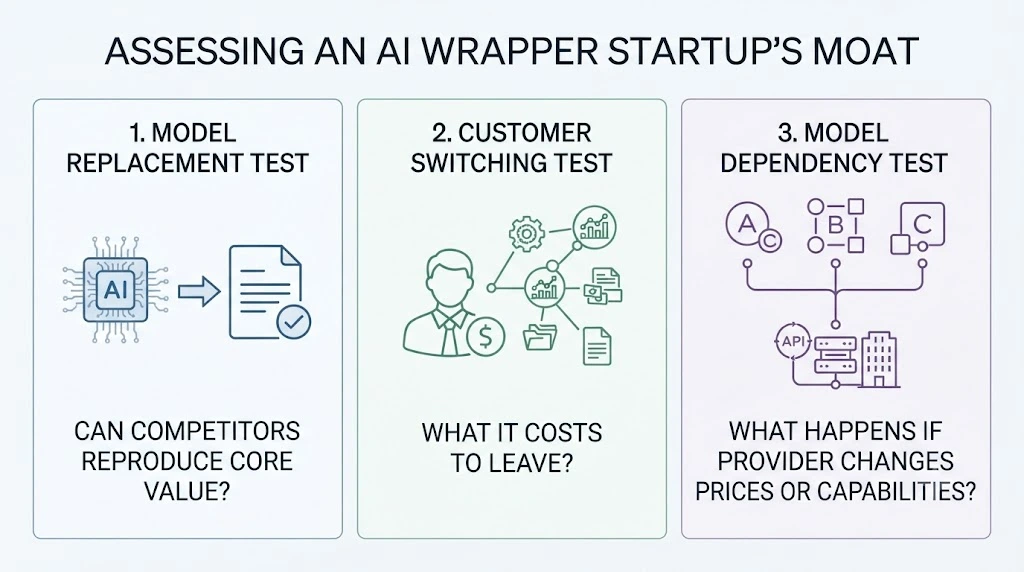
3 Tests to Assess Your AI Wrapper Startup’s Moat
Run these in order to test your AI wrapper startup moat. Each one takes an afternoon, and each ends with a short exercise you can do with a spreadsheet and a pen.
1. The Model Replacement Test: Can Someone Reproduce Your Core Value?
Start by listing every feature in your product. Next to each, write down how much of it depends on the model alone.
Now imagine your model provider ships that exact capability inside its own app next month. What survives?
Prompts and a clean interface are easy to copy. What’s harder to copy is specialized logic, your evaluation methods, and context that only exists because you’ve worked with specific customers.
Try this: Mark each feature as “copyable without our customers or systems” or “not copyable without them.” If most of your list lands in the first column, that’s your answer.
2. The Customer Switching Test: What Would It Cost to Leave Your Product?
Switching cost is not “they’d have to log in somewhere else.”
It’s the real work. Moving data, rebuilding workflows, retraining a team, and losing the context your product has built up over months.
Be careful with integrations. A connection to Slack or Google Drive feels sticky, but a customer can often rebuild it in an hour. That’s not a switching cost. That’s a setup step.
Try this: Write out, step by step, what a real customer would have to do to replace you. Count the steps. Then ask two customers if your list matches reality.
3. The Model Dependency Test: How Exposed Is Your Business to One Provider?
You can’t build a moat on ground that someone else can move.
Think about what happens if your provider raises prices, changes a capability, limits access, or updates its policies. How much of your product breaks, and how fast could you respond?
It also helps to know which parts of your system keep creating value no matter which model sits underneath. Those parts are your foundation.
Try this: Run a scenario. Your main provider doubles its price, or drops a feature you rely on. What happens to your margin and your product? Write down the plan you’d actually follow.
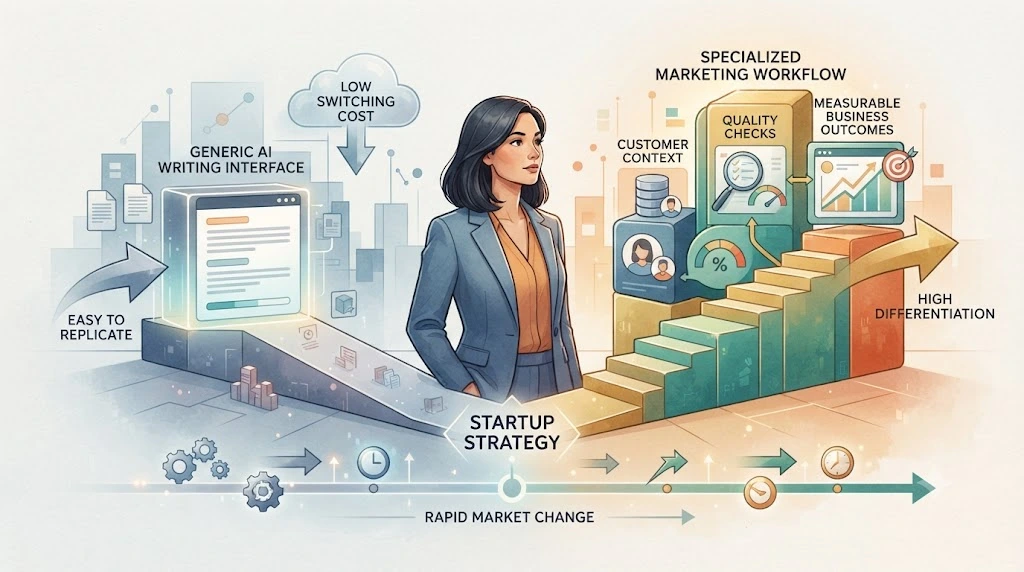
Weak AI Wrapper vs. Defensible AI Product
A simple wrapper can be a perfectly good business. The question is how much of its advantage a competitor could copy quickly.
Here’s how the two tend to look side by side:
| Area | Easy to copy | Harder to copy |
|---|---|---|
| Core value | A clean interface over the model’s output | Logic, context and workflow built around the model |
| Customer context | Generic inputs, nothing carried forward | Customer-specific context that improves results over time |
| Integrations | A connection customers can rebuild quickly | Integrations woven into daily work |
| Switching effort | A customer could leave in a day | Leaving means migration, retraining and lost context |
| Model dependence | One provider, and the product breaks if it changes | Providers can be swapped without losing quality |
| Evidence | A demo and a few testimonials | Retention, usage and outcome data |
| Improvement | Gets better only when the model does | Gets better through your own feedback and testing |
Two cautions. An integration is not automatically a switching cost, and stored data is not automatically a data moat.
Data only counts when you have the right to use it, it’s relevant to the task, and it measurably improves results. The scorecard below checks exactly that.
AI Wrapper Startup Moat Scorecard: Rate Your Product’s Defensibility
The tests tell you where the cracks are. The scorecard gives you a number to track. It also separates real defensibility from assumptions: permissions, measurable improvement, migration effort and customer outcomes all need evidence.
Score each of the eight rows below from 0 to 2:
- 0 = absent
- 1 = partly in place
- 2 = in place and you can show evidence
“Evidence” means something you could point to. A retention chart, a customer quote, a before-and-after comparison. A feeling doesn’t count.
| # | Dimension | What a “2” looks like |
|---|---|---|
| 1 | Value beyond the raw model response | Customers use you for something a plain chat window doesn’t give them |
| 2 | Customer-specific context or useful proprietary data | Your product gets better for each customer because of context only you hold |
| 3 | Recurring workflow dependence | The product sits inside a task customers repeat weekly or daily |
| 4 | Rights, consent and privacy controls | You have clear permission to use the data you rely on |
| 5 | Evidence that usage improves performance | You can show quality improving as usage grows |
| 6 | Actual customer migration effort | Leaving would take real, documented work |
| 7 | Model flexibility without losing product value | You can change or add model providers without materially reducing quality, workflow reliability or customer value |
| 8 | Measurable customer outcomes | Customers can tie your product to a result they care about |
Add up your score. The maximum is 16.
As a rough guide, a low total does not mean your product is bad. It usually means its current advantage depends heavily on the underlying model, a simple interface, or capabilities competitors can reproduce quickly. A middle total means you’ve got pieces of a moat but not the whole thing. A high total means you have real evidence behind your claims.
One caution. This is a diagnostic, not a prediction. A score of 14 does not guarantee success, and a score of 5 does not mean you’re doomed. Its job is to show you where to look.
When you’re done, write down your weakest dimension. That’s where the next 90 days go.
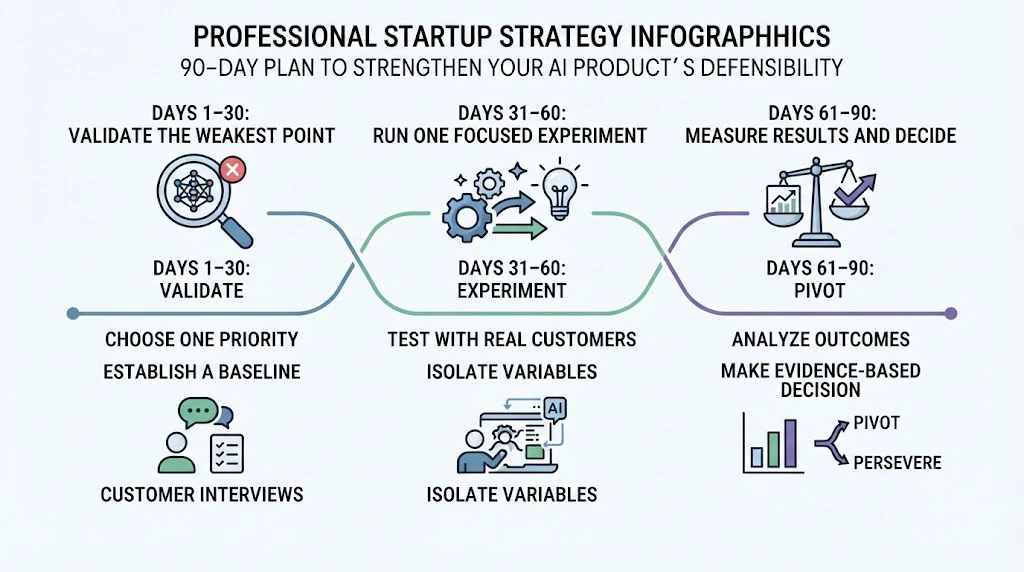
How to Strengthen Your AI Wrapper Startup’s Moat in 90 Days
Don’t try to fix everything. Pick one weak spot, run one experiment, and let the results decide what you build next.
In practice, most AI wrapper moats come from one of four places: customer-specific context, a workflow customers repeat, a feedback loop that improves results, or distribution and brand preference that make customers choose you. Your 90-day plan should strengthen one of these, not all four at once.
Days 1–30: Identify and Validate the Weakest Point
Talk to customers first. Ask them about the most important workflow they run with your product, and what they’d do if it vanished tomorrow.
While you’re at it, record your baseline: retention, repeat usage, customer outcomes and model costs. You can’t prove improvement later without a “before.”
Then choose one weak dimension from your scorecard.
Days 31–60: Run One Focused Defensibility Experiment
Match the experiment to the weakness. That might be a customer-specific context layer, a deeper step in the workflow, a feedback loop you can measure, or a distribution channel you can test.
If you plan to reuse customer data, sort out permissions and privacy safeguards first. It’s far cheaper to do this now than after a customer asks where their data went.
Compare your results against the baseline you recorded.
Days 61–90: Measure Results and Decide What to Build Next
Look at customer outcomes and product usage before and after the experiment.
Ask two blunt questions. Do customers actually care about this improvement? And would it be hard for a competitor to copy?
Then make a call. Continue, revise or stop. Stopping an experiment that isn’t working is a good result, not a failure.
Here’s a simple table to keep the plan honest:
| Priority | Experiment | Baseline | Success metric | Decision date |
|---|---|---|---|---|
| 1 | Add a customer-specific context layer | Current 90-day retention and weekly active use | Retention and repeat use improve vs. baseline | Day 90 |
| 2 | Add a second workflow step customers already do by hand | Time to complete that task today | Task time drops and feature adoption rises | Day 90 |
| 3 | Add a model-switching test harness | Current model cost per task | Same quality at a lower or steadier cost | Day 60 |
Swap in your own rows. The point is that every experiment has a baseline, a metric and a date.
How to Measure Whether Your AI Wrapper Startup Moat Is Getting Stronger
No single number proves you have a moat. Watch several signals together and compare them over time.
Good ones to track:
- Customer retention and repeat usage
- Time or effort needed to replace your product
- Improvement in output quality or task completion
- Gross margin and exposure to model costs
- Adoption of the workflow features customers rely on
- Customer-reported value and the reasons people renew
If you’re also trying to put numbers on automation payoff, the guide on AI automation ROI for startups pairs well with this list.
Check the trend, not a single month. A moat shows up as steady movement in the right direction.
Common Mistakes When Building an AI Wrapper Moat
These come up again and again. Most are easy to fix once you spot them.
- Treating a better prompt as a lasting advantage. Prompts are easy to copy and easy to outgrow.
- Assuming an integration creates switching costs. Many can be rebuilt in an afternoon.
- Calling customer data “proprietary” without checking rights. If you don’t have permission to use it, it isn’t an asset yet.
- Adding more models with no clear reason. Extra models should improve reliability, cost or quality. If they don’t, they add complexity.
- Building features before finding a problem worth defending. A moat around something nobody needs protects nothing.
- Claiming a moat with no evidence. If you can’t show better outcomes or retention, it’s a hope, not a moat.
For the bigger picture of how a moat fits into your overall approach, see our explainer on competitive strategy in business.
Frequently Asked Questions
Can an AI wrapper startup have a defensible moat?
Yes. A moat does not require owning the model. It can come from customer-specific context, workflow depth, quality systems, distribution, and the trust that makes customers prefer your product. The test is whether those advantages are hard for a competitor to copy quickly.
How do I know if my AI startup is just a thin wrapper?
Run the Model Replacement Test. If your model provider could add your main feature to its own product and customers would have little reason to stay with you, your current advantage is probably thin. If your value depends on customer-specific context or workflow depth, you have more defensibility than a basic wrapper.
Is proprietary data necessary for an AI wrapper startup moat?
Not always, but useful data helps. What counts is whether the data is relevant, whether you have the right to use it, and whether it measurably improves your product. Data you can’t legally or ethically reuse isn’t an advantage.
Do integrations create switching costs for AI products?
Sometimes, but less often than founders think. A simple connection is easy to rebuild. Switching costs appear when customers would lose workflows, history or accumulated context if they left.
How can an AI startup reduce dependence on one model provider?
Design your product so the model can be swapped. Build evaluation tests so you can compare providers on your own tasks, and keep the parts of your system that create value separate from any single model. Only add more providers if they improve cost, reliability or quality. If you’re deciding which workflows to automate first, see our guide on how to automate startup operations with AI.
How often should founders reassess their AI product’s moat?
At least once a quarter, and any time your model provider changes pricing or capabilities. The AI market moves quickly, so a moat you verified a year ago may not hold today.
Your Next Step: Score Your AI Wrapper Startup Moat This Week
You don’t need a big strategy offsite to start.
Set aside one hour. Fill in the scorecard, write down the evidence behind each score, and circle your weakest dimension.
Then book three customer calls and ask each one the same question: “What would you do if this product disappeared?”
Their answers will tell you more than any framework can. And if you want more practical guides like this for early-stage founders, explore the rest of the Startups category on FoundingMind and come back to re-score in 90 days.
Sources
- Maginative, “Jasper Appoints New CEO and Cuts Internal Valuation as AI Growth Slows”
- Contrary Research, “Jasper” company profile
- Bloomberg, “AI Marketing Startup Jasper’s CEO to Be Replaced With Ex-Dropbox President”
- Jasper, “Jasper Welcomes Former Dropbox President Timothy Young as CEO”
Figures and timelines are based on press reporting and third-party research, not audited financial filings.